Responsible AI Use

Working with AI tools is not just about knowing what they are and what decisions they make. It is also about using them responsibly in your day-to-day work. This means thinking carefully about what information goes into them, checking what comes out, and being honest about how you have used them. It also means choosing not to use them when that is the right answer. This section builds that practical side of the work.
This is not a section about the law. The law on data protection, equality and similar topics is its own subject. What this section is about is what good practice looks like on top of that. How decisions get made in a working day. What is expected of someone working with these tools.
What you’ll learn
- what information should not go into AI tools, and why
- how to check what an AI tool gives you before you act on it
- when and how to say you have used AI
- when the right answer is not to use AI at all
- where the main ethical lines sit on the use of AI, and what to do when you spot one being crossed
What you don’t put into AI tools
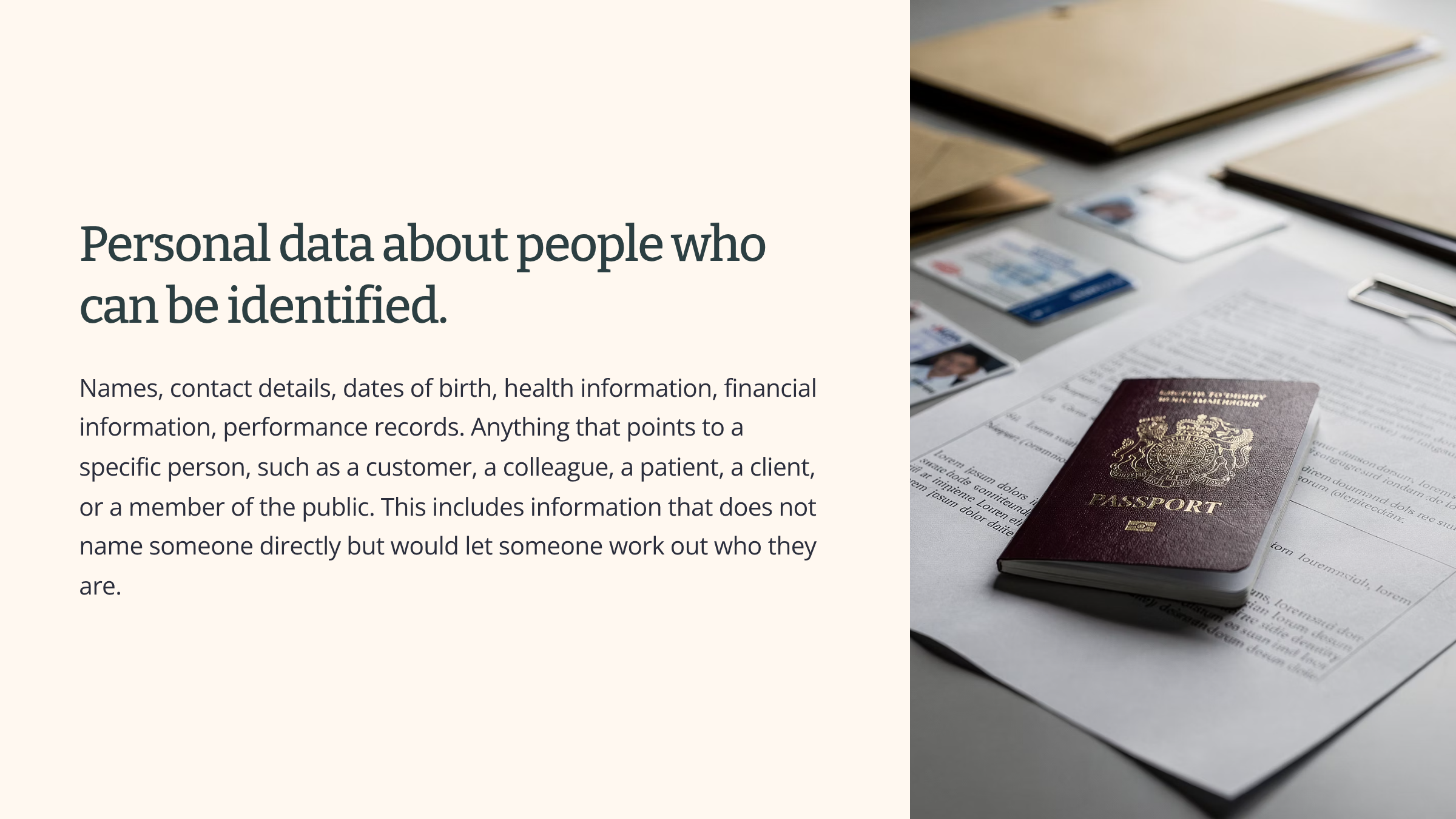
The starting point is this. Once you put something into a public AI tool, you have lost some control over where it ends up. The provider may store it. They may process it outside your organisation. They may use it to improve future versions of the tool. They may make it available to other parts of their service. You cannot easily get it back. You may not know exactly what happened to it.
There is an important point inside this. A public AI tool is one that anyone can sign up for and use through a free or personal account. That is not the same thing as an AI tool your organisation has approved, paid for and set up for the kind of work you do. These are different categories. The rules are different.
Many organisations have an approved version. It might be the same brand of tool you would meet on the public web, but in a paid setup that gives the organisation control over what happens to information that goes through it. In an approved tool, some of the information types above are allowed to go in, because the contract and the way it has been set up have made that safe. The approved tool is not a public tool with a different label. It is a different setup.
What you need to know in your role is two things. What the approved AI tools in your organisation are. And what each one is approved for. If you are not sure, ask before you put information in.
This applies to everything you give the tool, not just text you type. It applies to documents you upload, files you attach, screenshots you paste in, and information you describe. An AI tool cannot tell the difference between “the customer’s email said the following” and “here is the customer’s email.” Both have left your organisation. The check is the same in either case. Should this information be going into this tool.
See it in action
Someone in a customer service role is dealing with a difficult message from a client. The client is upset. The reply needs to be careful. The person decides to use a public AI tool to help draft something good.
Watch what is about to happen.
The original message is open in front of them. It contains the client’s name, the details of the situation, and several comments the client has shared in confidence about their own situation. The plan is to paste the whole message into the AI tool with a prompt asking for a careful reply.
At this point, the person stops. They look at what is on screen. The message contains personal details about the client. It contains things the client said in confidence. None of this is information that should go into a public AI tool.
The right move is one of three things.
If the organisation has an approved AI tool that is allowed to handle this kind of information, use that one instead.
If there is no approved tool for this, rewrite the task so the AI does not need the confidential details. Ask for a draft reply to a complaint about a delayed service, without naming anyone or including the client’s specific details. Then take that draft and shape it for the actual message.
If neither of those works, draft the reply without AI help. The work still gets done. It just gets done another way.
The decision the reader sees here is not “should I use AI.” It is “should this information go into this tool.” Once that question is asked clearly, the answer in this case is no.
Checking what AI gives you
AI tools produce fluent, confident, well-written output. The grammar is good. The structure makes sense. The tone is right for the task. None of that tells you whether the content is correct.
This is the trap. When something reads well, the brain accepts it. When it sounds confident, the brain accepts it. The fluency and the correctness are not the same thing, and AI tools are very good at the first whether or not they get the second right.
Anything you intend to act on, share, or put into work that another person will rely on needs to be checked before it goes anywhere. What checking means depends on what the AI has produced.
Checking a factual claim
If the AI tool has made a claim about the world, that claim needs to be checked against a source you trust. A date. A number. A piece of law. A case. A statistic. A fact about a person or an organisation. Any of these can be wrong even when the surrounding text reads well.
Modern AI tools often cite sources for the claims they make. This makes checking easier. You can follow the cited source and confirm that the source actually says what the tool says it says. Easier is not the same as automatic. The tool can misread a source. It can pick out the wrong sentence. It can attribute something to a source that is about a different topic. A cited source is a starting point for checking, not the end of it.
Checking a generated document
If the AI tool has drafted a document for you, it needs to be read by a person with the knowledge to spot mistakes before it goes out. The document might be an email, a report, a piece of text or a set of slides. The check is the same in each case. The common failure points are names, figures and specific claims. The names of people. The names of products. The numbers in tables. The statements about what someone has said or done. These are the parts the AI most often gets wrong, even when the rest of the document is right.
Reading the draft is not the same as reading it for these specific things. Read it once for sense. Then read it again to check the names, the numbers and the specific claims, with the source material in front of you.
Checking code
If the AI tool has produced code, it needs to be read and tested before it runs in anything that matters. Code that looks right can do the wrong thing. The variable names look sensible. The logic looks like the kind of logic that would solve the problem. The output of the code is what tells you whether it works. Run it on a known input and see if you get the right answer. Try it with unusual inputs too. The kind of inputs that might confuse the code. If it is going into something live, have someone with the right skills look at it before it goes there.
Checking a classification or extraction
If the AI tool has sorted things into categories, or pulled specific information out of documents, the result needs to be spot-checked. Read a sample. Confirm that the sorting or the extraction is right on those samples. Look for patterns of error. AI tools often go wrong in consistent ways, such as putting one type of thing in the wrong category, or always missing a certain piece of information. Spot-checking is how you catch the pattern early.

Where to put checking effort
The amount of checking an output needs depends on the consequences if it is wrong. A rough draft of a personal note needs less checking than a message going to a client. A message going to a client needs less checking than a decision affecting someone’s money, their job or their health. The principle is straightforward. The bigger the consequences, the more checking the output needs.
If an output will be acted on by another person, treat checking as part of the work. Not as an extra step you might skip if the day is busy. The same applies if the output could affect someone in a real way.
What checking doesn’t mean
Checking is not the same as reading the output and feeling that it looks right. Looking right is what AI tools are good at. The output will almost always look right. The check is whether it is right. That means going back to a source. Comparing what was written against what was supposed to be written. Running the code. Reading the cited material. The check has to involve something outside the output itself. If the only thing you have done is read the output, you have not checked it.
See it in action
Someone in a working role uses an AI tool to produce a short briefing note on a regulatory requirement for a colleague. The note will be used in a meeting that afternoon. The AI tool produces a confident, well-written note of around 400 words. The note cites two sources at the bottom.
The person reads the note. It reads well. The points are clear. The sources are named, with links. It looks ready to send.
Watch the check happen instead.
The first cited source is followed up. The link works. The page loads. The page is a real document. The person reads the relevant section. The source does not say what the AI tool claims it says. It is close, but the meaning is different. The tool has used the source to support a point the source does not actually support.
The second cited source is followed up. This one does say what the tool claims. It supports the point fully.
What the person now knows is that the briefing note is not safe to send as it stands. One of the two sources backs the claim and the other does not. Without the check, the note would have gone out with one false statement that looked properly sourced.
What the reader sees is the gap between “the AI cited a source” and “the source supports the claim.” The first is information about how the output was produced. The second is the only thing that matters when someone is going to act on it. Closing that gap is what checking does.
Disclosing AI use
If you have used an AI tool to produce something another person will read, act on or rely on, they often expect to be told. They might assume the work is your own thinking. They might reach a different judgement about how to review it if they knew AI had been involved. They might have rules in their own role about handling AI-produced material. Saying you have used AI is how you respect that.
When you are expected to say
You are usually expected to say AI was used in these situations:
- Work going to a client or customer, where they may assume they are getting the personal work of the person who wrote to them.
- Work going to a manager or a colleague who will act on it, where the difference between “I drafted this” and “I had AI draft this” matters for how they review what is in front of them.
- Published or external content, where there may be audience expectations or organisational rules about AI-produced material.
- Academic, regulated or formal contexts, where specific rules about AI use apply.
- Creative or credited work, where the question of who produced it is part of what is being communicated.
When you are not usually expected to say
You are not usually expected to say AI was used in these situations:
- Routine internal drafting where AI is used as a starting point, and the output is reviewed and shaped a lot by the person sending it.
- Using AI to help think through a task that you then write yourself.
- Using small AI features built into everyday tools, such as a grammar suggestion, a formula prompt in a spreadsheet, or a reply suggestion in an email program.
The line between the two is not a perfect one. The honest test is whether someone receiving the work would reasonably want to know that AI was involved. If the answer is yes, say so. If you are not sure, the safer thing to do is to say.
How to say it
Saying you have used AI does not need to be long. A short, clear note is the standard form. A line at the top or bottom of an email. A footer on a document. A short note in a published piece. The note gives information. It is not an apology. You are not asking permission. You are telling the reader what they need to know to handle the work properly.
Examples of how this looks in practice:
- “Drafted with AI help and reviewed by me” at the bottom of an email.
- “First draft produced with AI, shaped and checked by me” at the top of a report.
- “Some passages in this article were drafted using AI tools” as a note at the start of a published piece.
The wording is less important than the fact. What matters is that the person receiving the work has the information.
What organisations are doing
Many employers now have policies on AI use. The policies cover what tools are approved for which kinds of work, when AI use must be made clear, and what counts as making it clear. Knowing your own organisation’s policy is part of working responsibly. Where no policy exists yet, the principle still applies. When in doubt, ask. Asking is always better than guessing.
See it in action
Someone in a working role uses a specialist AI tool to produce the first draft of a quarterly report. The report will go to senior colleagues that week. They feed the AI tool a set of figures, an outline, and last quarter’s report for context. The tool produces a 12-page draft.
The person spends an hour shaping the draft. They correct a number of figures the tool got wrong. They add their own analysis in two sections the AI did not get right. They restructure the conclusion. They cut one section the AI included that was not relevant. By the time the draft is ready to share, the report carries their thinking in a way the original draft did not.
Now they decide what to say about how it was made.
This is not a case of “I had AI write this and now I am sending it on.” That would understate the work that went in. The senior colleagues should not assume the draft is unfiltered AI output, because it is not. It is also not “I wrote this from scratch.” That would be untrue. The structure, the language and the first version of the analysis came from the AI tool. The person did real work on top of it, but they did not do all of the work.
The right form is something in the middle. A short line at the top of the report. “First draft produced with AI, shaped and checked by me.” Two facts. Both true. Both useful for the readers.
The reader watches the decision being made. The person did not refuse to say. They also did not claim more than was true. They told the readers what they needed to know to handle the report properly.
When not to use AI
Responsible use includes knowing when the right answer is not to use AI. This is not a backup option. It is a decision that comes up often in real work. The question is not “can AI do this.” The question is “should it.” The two are not the same.
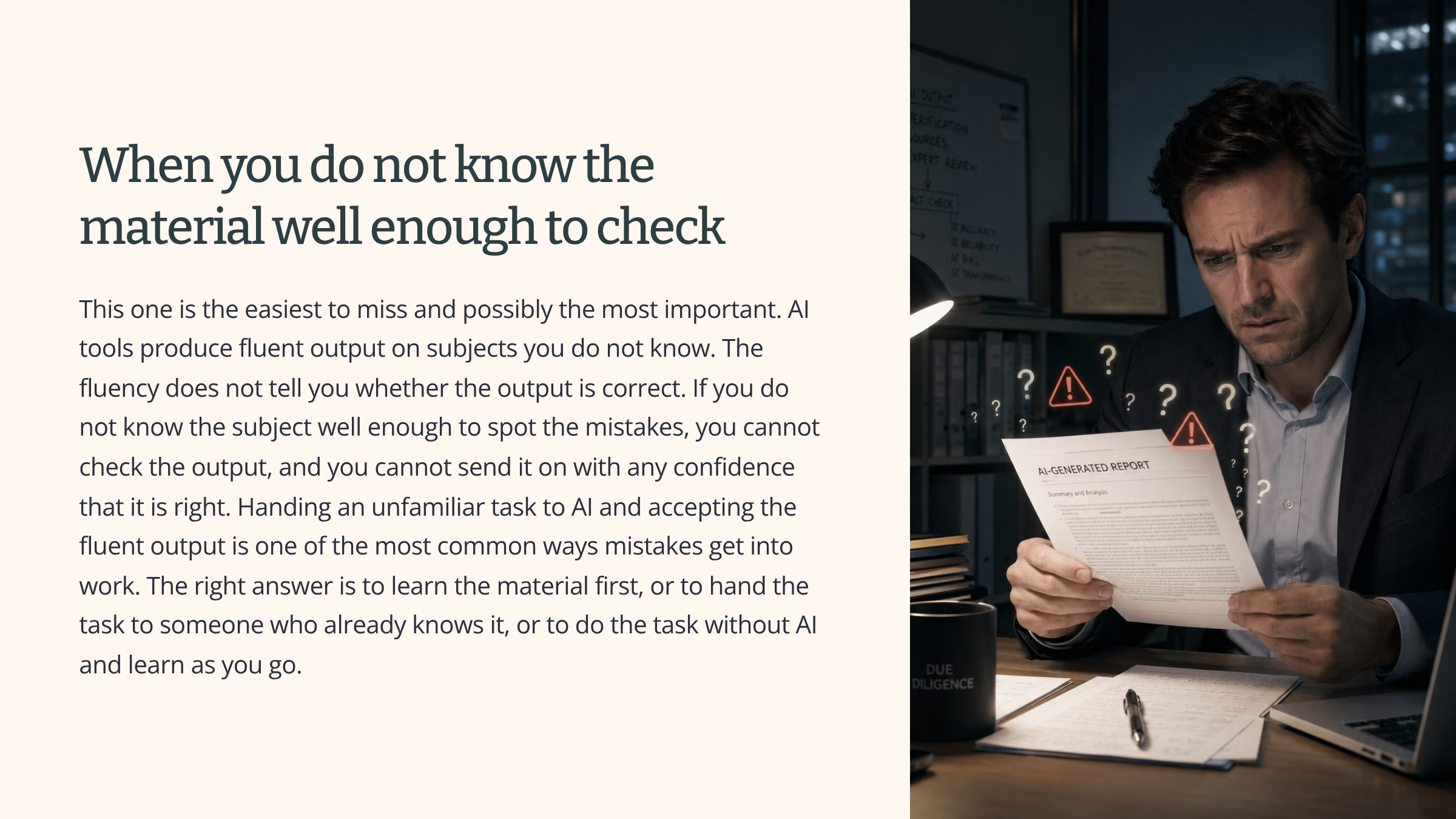
There are six situations where the responsible answer is to do the work without AI.
How to say no in practice
Saying no to AI use is a normal professional decision. It is not a refusal to be helpful. It is not a confrontation. A short, clear sentence is enough.
Examples of how this sounds:
- “I’ll draft this one without AI. The content is sensitive and I want to write it myself.”
- “We’re not using AI for this because the information cannot go into an AI tool.”
- “I’ll handle this one directly.”
You do not need to apologise for the choice. You do not need to explain at length. The person you are speaking to is asking you to do good work. Saying no to AI for this piece of work is part of doing it well.
Who decides
In your role, you are expected to make this decision yourself. You are not expected to check with a manager every time. The decision about whether to use AI for a piece of work is yours, and the responsibility for that decision is yours too. That is what the role asks of you.
See it in action
Someone has been asked by their manager to handle a piece of work involving a complaint about a colleague’s conduct. The complaint is from another member of staff. The matter is sensitive and is going to need careful handling. The manager finishes the briefing with “use AI to speed this up where you can, we need it done by Friday.”
Watch what the person thinks through.
The intent behind the manager’s suggestion is good. The manager wants the work done in time. The manager has not paused on the specific question of whether AI is the right tool for this specific piece of work. That pause is the person’s job to make.
The information involves a named colleague, the details of the complaint, and confidential statements from others. None of this is information that should go into a public AI tool. The judgement at the centre of the work is the kind a tool cannot exercise. What the complaint is about. What kind of response is appropriate. What tone is needed. Those are decisions a person needs to make. The consequences of getting any of this wrong are serious for the people involved.
The right response is short and clear. The person says back to the manager something like “I’ll do this one without AI. The information cannot go into an AI tool, and the judgement here needs to be mine. I’ll get it done by Friday.” The manager has the answer. The work gets done another way. The relationship is fine. The colleague who raised the complaint is handled properly.
The reader watches the whole sequence. The manager’s good intent. The pause. The reasoning. The clear short reply. The work continuing without AI. None of it is a confrontation. None of it is a problem. It is what responsible practice looks like in a working day.
Uses of AI that cross ethical lines
So far this section has been about what you do as the person using AI. What you put in. What you check. What you disclose. When you choose not to use it.
There is another side to this. Some uses of AI cross ethical lines no matter who is using the tool or how careful that person is. These are uses that cause harm to people, breach trust, or remove fairness from a process. Knowing where these lines sit is part of working responsibly with AI. If you are asked to help build, set up or run a system that crosses one of these lines, the right response is to raise it rather than carry on.
There are five lines that matter most. They come up in regulation. They come up in court cases. They come up when AI projects go wrong in ways that make the news. They are connected. A project that crosses one of them often crosses two or three.
Biased decisions at scale
AI tools learn from data. If the data they learn from reflects unfair patterns from the past, the tool will repeat those patterns going forward. This is the most documented harm in AI use, and good intentions do not solve it.
Some examples of how this shows up in real systems:
- A hiring tool trained on past “successful hires” that learns to prefer candidates who match the people the organisation has hired before, including patterns no one wanted to keep.
- A customer service tool that gives faster responses to groups who historically complained more loudly, leaving other groups underserved without anyone realising.
- A performance management tool that rates people on measures that reflect old assumptions about what good performance looks like.
The harm is that the bias spreads further and faster than any one person could spread it. The output looks neutral. The output is not neutral. It is the past, automated.
Fully automated decisions about people, with no human review
Some decisions affect a person’s life in important ways. Whether they get a job. Whether they get a loan. Whether they keep their place on a service. Whether they get flagged as a problem.
When AI is used to make these decisions on its own, with no person checking the outcome and no clear way for the affected person to challenge it, an ethical line has been crossed. UK and EU rules already restrict this, and the rules are getting tighter.
The line is not “AI helped with the decision.” The line is when AI made the decision on its own. No person was meaningfully involved. The affected person has no real way to push back. If a tool is being used in that way, that is a problem to raise.
Watching employees in ways that go too far
AI tools can monitor people at work in ways that were not possible before. Keystroke tracking. Screen activity scoring. Tone analysis of emails and chats. Productivity ratings based on behaviour patterns. Camera-based attention tracking.
Some of this can be done lawfully if it is clearly explained, agreed and limited in scope. A lot of it is being done in ways that are none of those things.
The line is crossed when monitoring is done in secret, without consent, or at a level of detail that treats people as data points rather than professionals. The harm is real. People feel watched. Trust drops. Wellbeing drops. The work gets worse, not better.

Using personal data in ways people did not agree to
Putting confidential information into an AI tool is one risk, and you covered it earlier in this section. There is a wider version of the same problem. Personal data can also be misused at the level of how the AI tool itself is built, trained or run.
This includes:
- Scraping personal details from the public internet to build marketing lists or training sets, without the consent of the people involved. This often breaches data protection law as well as being unethical.
- Using customer or employee data that was given for one purpose to train an AI tool for a different purpose.
- Combining datasets from different places to build deeper profiles of people than any of the original sources allowed.
- Using someone’s image or likeness to create AI-generated marketing material without their permission.
- Producing fake images, audio or video of real people for any purpose other than ones they have agreed to.
The principle is straightforward. Information about a person belongs to that person. Using it in AI without their agreement is a breach of trust, and often a breach of law as well.
Black box decision-making
Some AI tools produce decisions no one can take apart and review afterwards. Even the people running the tool cannot explain why a particular decision came out the way it did. This is what is meant by a “black box” system.
If someone asks “why was this application rejected” and the answer is “the model said so” with no further explanation possible, the system has crossed a line. The same applies if a tool gives recommendations the user cannot question, or if there is no record of how a particular output was produced.
The line is crossed when accountability disappears. A decision that affects someone has to be a decision someone can answer for. If the system is set up so that no one can, the system should not be making that kind of decision.
Other things to be aware of
The five above are the main ethical lines. There are others worth knowing about:
- Manipulating customers through AI insights. Pricing or messaging that exploits behavioural patterns rather than serves the customer fairly.
- Replacing human contact with AI in situations that need empathy. Chatbots taking the place of a person in a conversation that is genuinely difficult for someone.
- Misrepresenting AI-generated work as expert human work. Producing a report with AI and presenting it as expert analysis.
- Claiming AI is doing more than it is. Calling something “AI-driven insight” when it is basic automation.
- Using AI in ways that strip skill and learning out of jobs over time.
- Putting AI tools into use without testing them properly first.
- Treating AI as the decision-maker so no person has to take responsibility for what it produces.
These are smaller risks individually but they often turn up alongside the main five. Knowing them by name helps you spot the patterns.
Why this matters in your role
You may not be the person making the decision to bring in a particular AI tool. You may be the person who is asked to:
- help build it
- set it up
- write a prompt for it
- run it
- rely on its output
In any of those positions, you can spot when one of these lines is being crossed. Spotting it and raising it is part of the role.
The pattern most of these issues share is this. Someone is using AI to make work faster or cheaper without thinking carefully about the impact on the people on the other end of the system. That gap, between speed and impact, is where ethical AI use breaks down.
See it in action
Someone in a working role is asked by a manager to help set up an AI tool that will score incoming job applications. The plan is for the tool to give each application a score, and the recruitment team will only review applications above a certain score. The manager is excited about the time it will save.
Watch what the person thinks through.
The person is in a position to ask the questions that need asking. The first one is what data the tool was trained on. The answer is “our previous successful hires.” That answer alone is a problem. If those past hires reflect any unfair patterns, the tool will repeat them.
The second question is whether a person will look at the lower-scored applications. The plan says no. Those applications will be filtered out automatically. The combination of biased training data and no human review crosses two ethical lines at once.
The third question is whether a rejected applicant could challenge the decision. The honest answer is they would not even know an AI tool had been used.
The right response is not to refuse on the spot. The right response is to raise the concerns clearly. The person says back to the manager something like “before we set this up, there are three things we need to work through. The data the tool will learn from. Whether a person will look at the lower-scored applications. And what we tell applicants about how decisions are made. I am not saying we cannot use AI in this process at all. I am saying those three things need answers first.” The manager has the information. The conversation moves to the right place.
The reader watches the whole sequence. The exciting time-saving idea. The pause. The three questions. The clear short raising of the issue. None of it is a confrontation. None of it is unhelpful. It is what responsible practice looks like when an AI use case might cross an ethical line.
Summary
Responsible AI use is what good practice with these tools looks like in everyday work. AI tools are useful, sometimes very useful, but they are not magic and they are not safe by default. The moment you decide to use one, what comes out of it is your responsibility.
Strong practice means thinking carefully about what information goes into an AI tool. It means checking what comes out before acting on it. It means being honest about how AI was used. It means choosing not to use AI when that is the right answer. And it means spotting when the use itself crosses an ethical line.
When you work in this way, responsible AI use is not an extra task on top of the job. It becomes part of how you think and act whenever you reach for these tools.