Workforce, Culture and Wellbeing Impacts of AI Adoption
AI does not arrive in a workplace as a neutral piece of technology. It arrives into people’s working lives. It changes what they do, how they do it, how they feel about their work, and what the place around them is like.
Some of these changes happen quickly. Others take months to show up. Some are easy to see from the outside. Others are felt only by the people directly affected.
In this section you will learn
- What AI-driven changes look like in real work situations
- Common patterns in how work itself is affected
- Typical concerns raised by the people doing the work
- The impact of AI adoption on team and organisational culture
- Effects on wellbeing across individuals and teams
- The difference between real-world impact and planned rollout expectations
- Recognising and understanding these effects as they actually happen
The main patterns of workforce impact
When AI is introduced into a workplace, the impact on the work tends to follow recognisable patterns. There are six of them.
These patterns are not all separate options. A single AI tool can produce more than one at once, and the patterns often shift over time as the tool gets used in different ways. You will likely see more than one of these on any team where AI has been brought in.
The six patterns are:
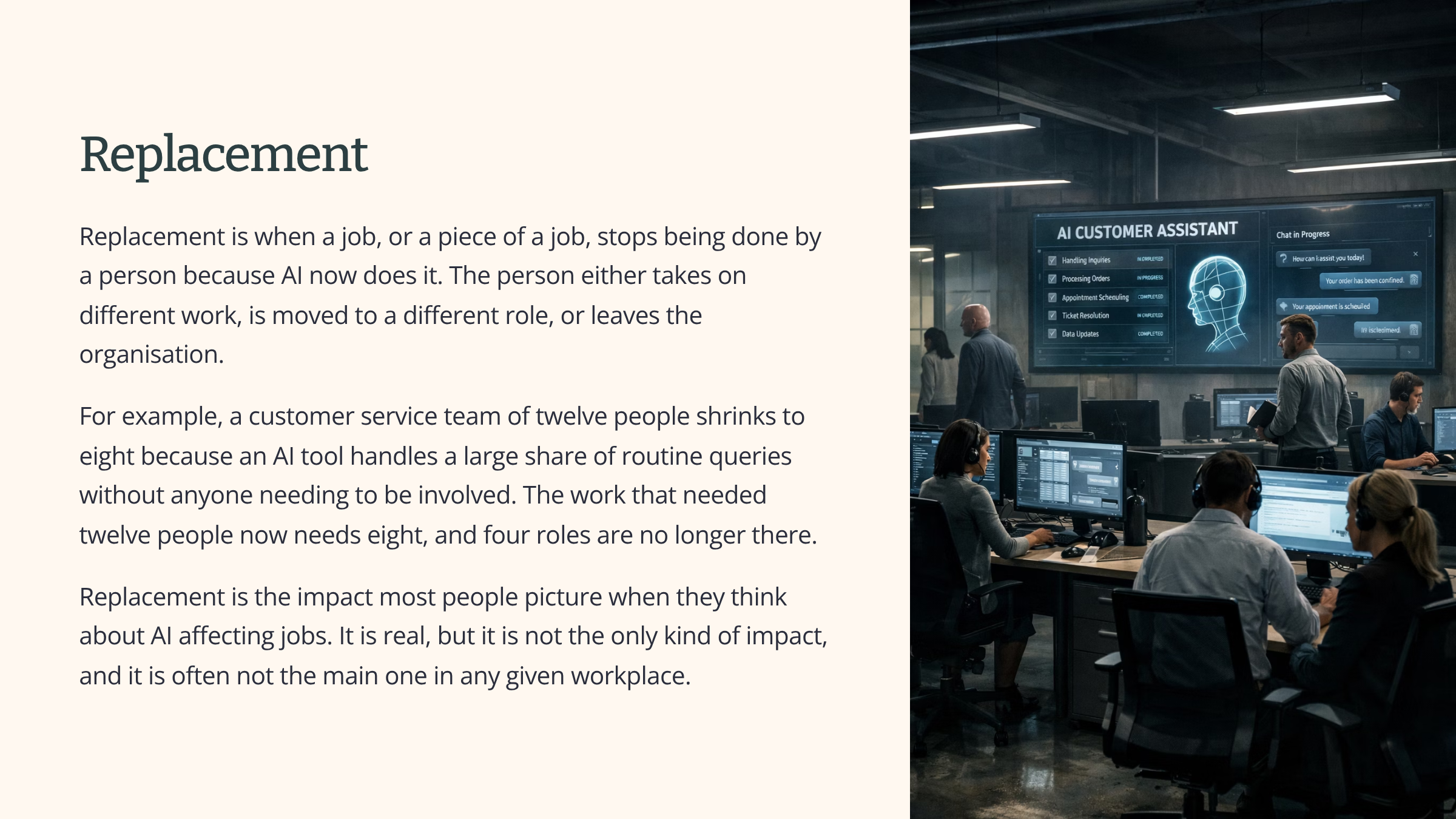
- replacement
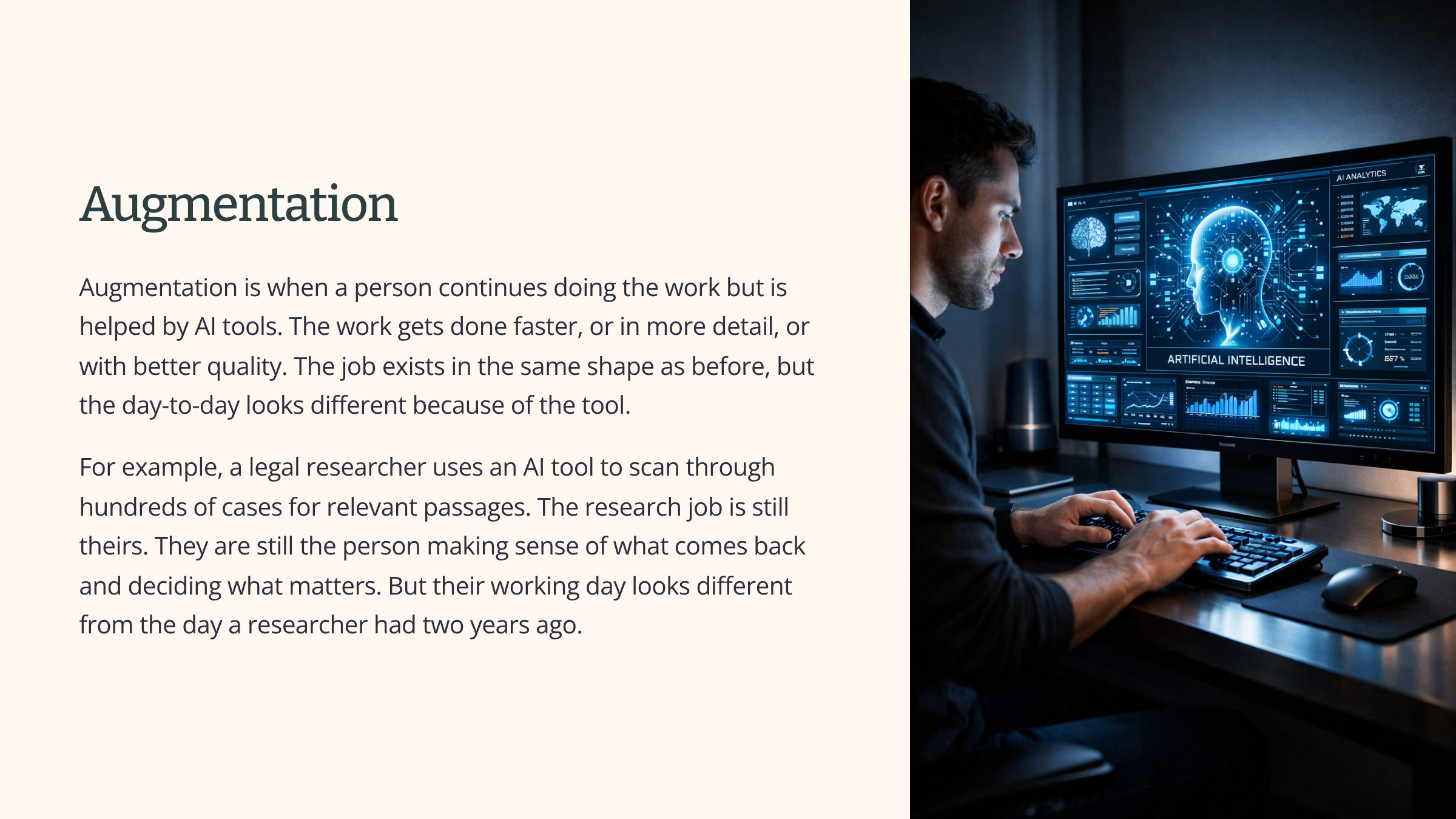
- augmentation
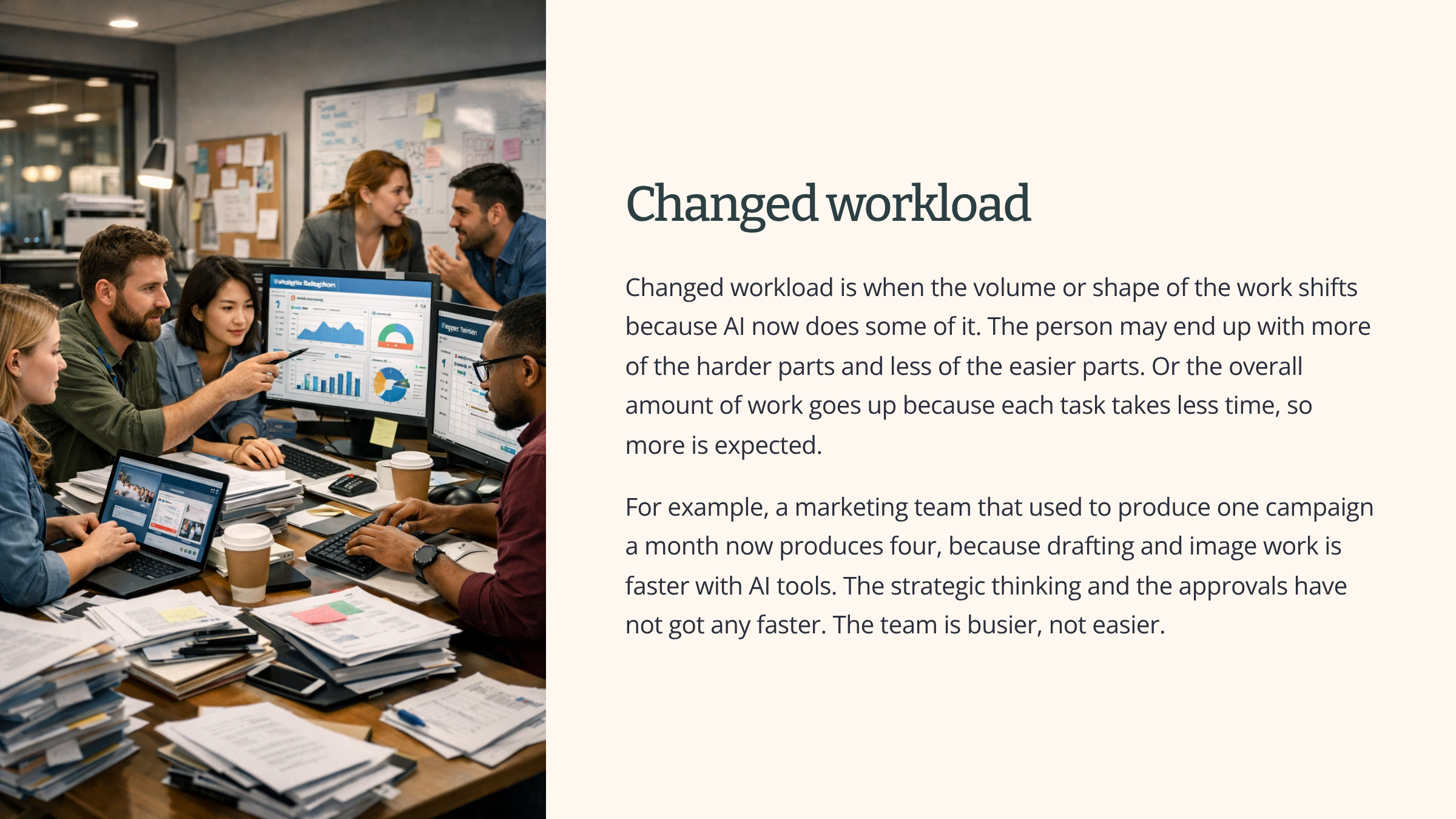
- changed workload
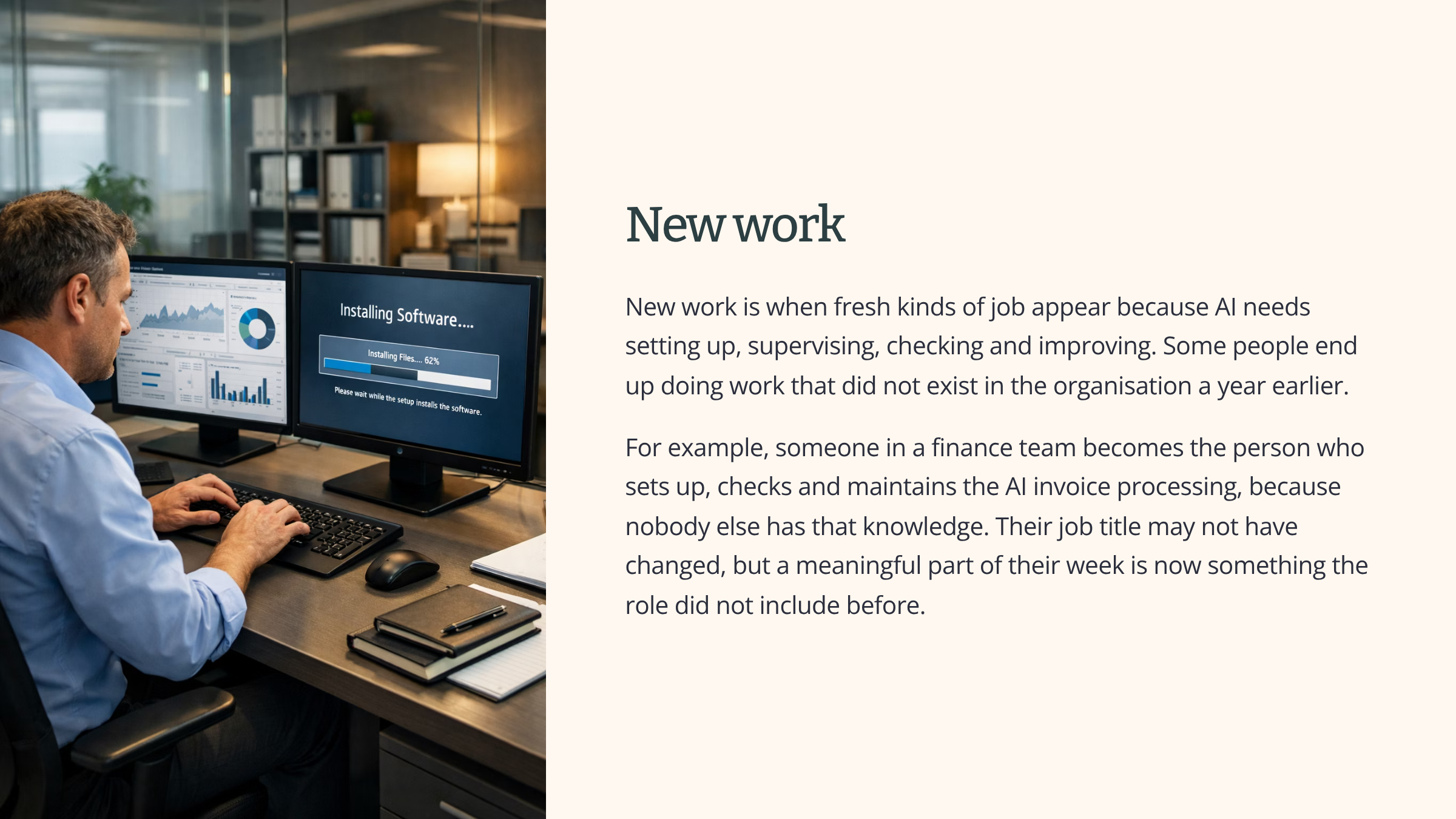
- new work
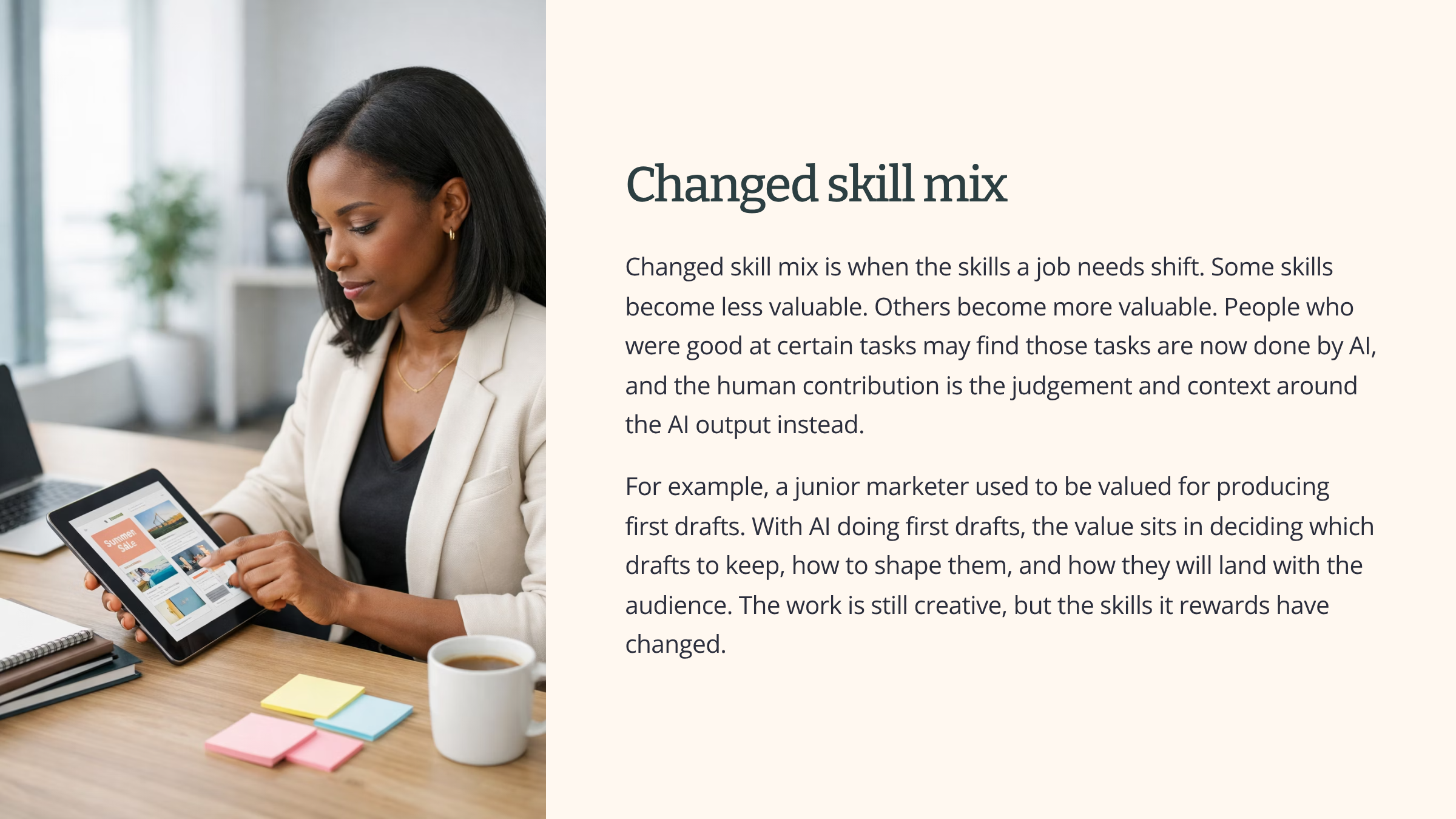
- changed skill mix
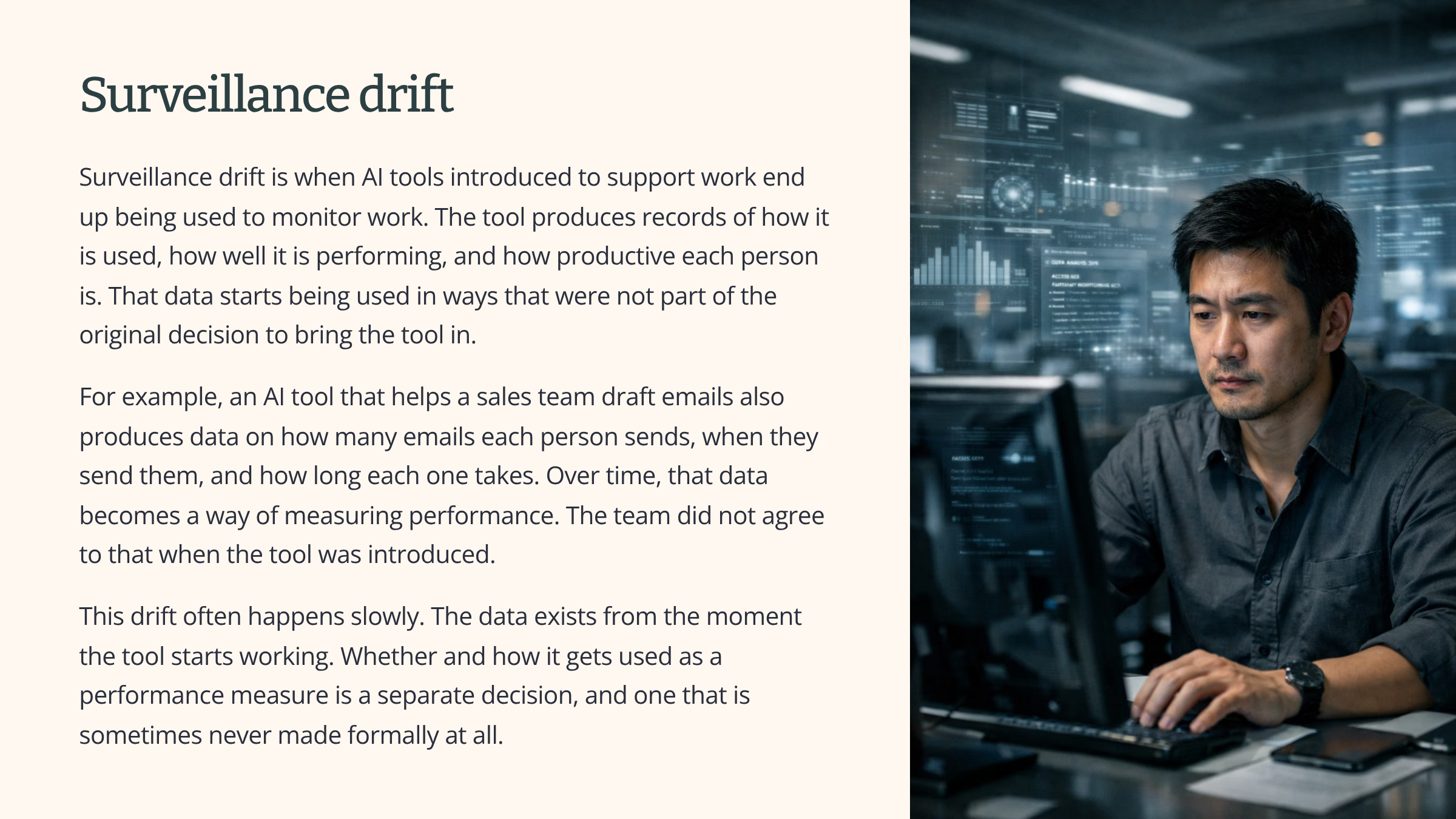
- surveillance drift
See it in action
A team of ten people in a professional services firm starts using an AI tool to help with case write-ups. The tool was introduced as augmentation. Each person still does the work, and the tool helps them get drafts together faster.
In the first month, the team is mostly relieved. The tool takes care of the parts of the write-up that people enjoyed least.
By month two, the picture is more mixed. The team leader has noticed how much faster the tool makes things, so the volume of cases the team is expected to handle has gone up. Pace has risen across the week. Changed workload has surfaced.
By month three, the day-to-day work has shifted again. The drafts come out of the tool quickly, but they need careful checking. The work is now mostly checking and refining, not producing. Some of the team are good at this. Some are not. Changed skill mix has surfaced.
At the end of month three, the team leader starts looking at the tool’s usage data. How many cases each person processed. How long each one took. Quietly, that data begins to shape how individual performance is talked about. Surveillance drift has started.
The original decision was to introduce the tool as augmentation. Three months in, three different patterns are visible at the same time. None of them was named in the adoption plan. They unfolded as the tool got used.
This is what the patterns look like in practice. They do not always show up at once, and they are rarely predictable from the moment a tool is brought in.
The concerns people have
When AI moves into people’s work, certain concerns come up again and again. These are not unreasonable worries. They are what sensible people in working life feel when AI starts taking on parts of the work that used to be theirs.
The concerns vary between organisations and between individuals. Some come up loudly and early. Others stay quiet for a long time. The shared point across all of them is that they are real, not imagined.
There are six concerns that come up most often.
Job Security
Concern about job security
This is the most common concern, and often the loudest. Even where no replacement is planned or likely, people notice that AI is moving into work that used to be theirs, and they wonder what comes next. People in roles that look more vulnerable from the outside, such as administrative, customer-facing or content-producing roles, often feel this more strongly.
Their Role has no Meaning
Loss of the meaningful parts of the job
People often did not only value the outputs they produced. They valued the thinking, the craft and the judgement that went into making them. When AI takes over the parts of the job that felt most like their own work, the job can feel empty even when it still exists.
For example, someone whose strength was in producing strong analysis may now feel they are reviewing and tidying AI output rather than doing the analysis themselves. The output looks similar from the outside. The work feels different to do.
Their Experience Means Nothing
Worry that experience no longer counts
This is the worry that years of experience in doing something well are being made irrelevant. Someone who built their career on being fast and accurate at a particular task now sees AI being faster and more accurate. The career path they were on may no longer exist in the same shape, and the skills they invested years in may not carry the same value any more.
Being Judged By AI
Being judged by AI
People increasingly work alongside tools that watch their work and score their performance. The same tools suggest what they should do and produce data on how they compare to others. The worry is that an employer now has an AI-shaped picture of them that they cannot see, cannot challenge and cannot control.
It is one thing to be assessed by a manager who knows the work. It is something else to be assessed by a system whose reasoning is hidden.
Last in the Chain
Being the last human in the chain
When AI does most of the work and a person is there to catch errors, the work becomes a kind of supervision job. It is less varied than the original job. There is less to do that feels creative, and the moments of decision are mainly about whether the AI got something right rather than what to make from scratch.
People know when their job has shifted in this direction, and they often resist it, because the work itself has lost something they valued.
Trust and Understanding
Having to use tools they do not trust or understand
Sometimes people are asked to use AI tools they did not choose. They may not fully understand how the tool works, and they may not be sure the tool is producing the right output. Even so, they are expected to take responsibility for what comes out of it. If something goes wrong, it is their name on the work, even though the tool produced it.
This is a particular kind of stress. It is not the stress of having too much to do. It is the stress of being held responsible for something they cannot fully check.
These six concerns are about more than fear of being replaced. They are about meaning, fairness, control and being held responsible. A list of likely workforce impacts in an adoption plan rarely captures any of this. The concerns also surface differently in different workplaces. A pattern that is loud in one team may not show up in another. The point is not to predict which concerns will appear where. The point is to recognise them honestly when they do.
See it in action
A team of six is six months into using an AI tool that was brought in to help write client reports faster. The tool works. The reports go out quicker than they used to.
In a regular meeting with their manager, a team member raises some of what they have been noticing.
They mention that report writing used to be the part of the job they enjoyed most. Now they are checking AI drafts rather than writing from a blank page. They are not asking to go back. But the work has changed shape, and they want it acknowledged that the change is real.
They mention that the tool produces data on how many reports each person edits and how long each one takes. They have not been told that data is being looked at. But they are aware that it exists, and they have started to wonder.
They mention that on a recent report, the AI output included a small but important error that they only caught on the second look-through. Their name went on the final report. If they had not caught it, it would have been their problem.
The line manager listens. None of these are formal complaints. None of them are unreasonable. None of them were in the documents that justified bringing the tool in.
The picture in this conversation is different from the picture in any rollout report. The reports are going out faster. That is true. The team’s relationship to the work has also changed. That is also true. Both things are real at the same time.
Culture and wellbeing effects
AI adoption does not only change specific jobs. It also changes the shape of the workplace those jobs sit in. The effects show up in the culture of a team or organisation, and in the wellbeing of the people working in it.
These effects tend to surface slowly. They are often not noticed by the people most responsible for the adoption decision, because those people are not usually the ones the changes happen to.
There are five culture effects and five wellbeing effects worth knowing about.
Culture effects
These effects show up in how a team works together. They show up in what is treated as normal. And they show up in how people see each other’s work.
The “who is using AI” divide
In many workplaces, some people use AI tools heavily. Some refuse to. Some are in between. This creates a quiet divide about what normal work looks like. The heavy users produce more output and may be seen as more productive. The non-users feel that their careful, traditional work is undervalued. Often there is no formal policy guiding any of this, and the divide deepens without anyone naming it.
AI use as an unspoken norm
Once AI tools are available and visible, not using them starts to feel like falling behind. People feel pressure to use them even when they are not sure the use is appropriate, and even when they are worried about the output. Nobody has asked them to. The pressure is cultural rather than instructed.
Suspicion about the source of work
People start wondering whether a colleague’s email, report or suggestion was written by AI. Work that used to be accepted without question now carries a small layer of doubt about who or what produced it. This changes how people respond to each other’s work, often without anyone saying so out loud.
Flattening of voice and craft
When AI is used heavily for written work, the output starts sounding the same across the organisation. The particular voices and styles of individual people can get smoothed out. What used to feel like the way one person writes becomes harder to tell apart from the way another person writes, because both are now being shaped by the same underlying AI tool.
Speed becomes the new baseline
AI-assisted work is often much faster than the work it replaces. Once people in an organisation see this, the expectation of how long work should take shifts. Work that took a morning before can now be expected by the end of the hour, whether or not AI was actually used to do it. The new pace becomes the norm, and the older pace starts to look slow.
Wellbeing effects
These are the effects that show up in how the people doing the work feel, both day-to-day and over time.
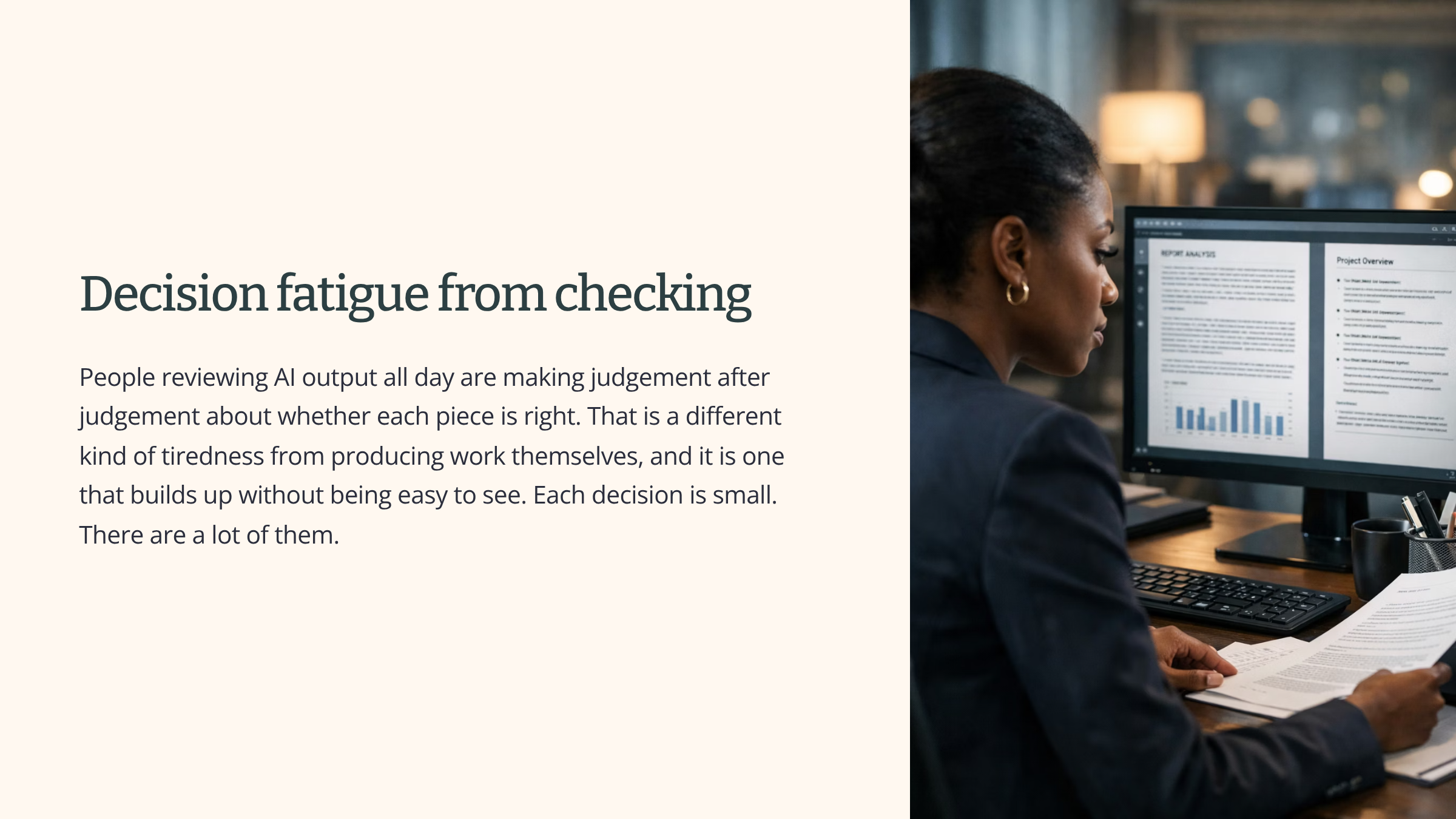
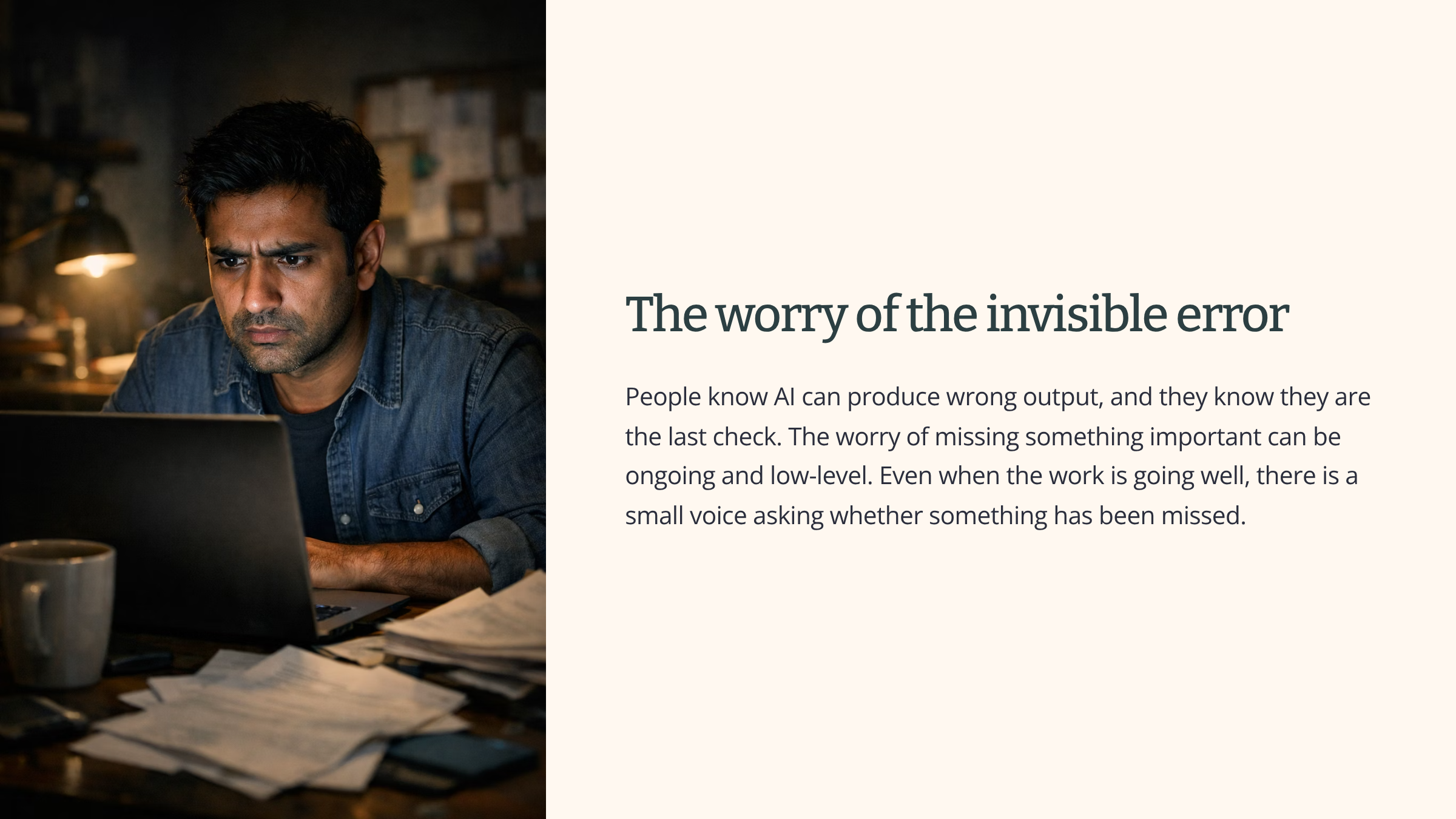
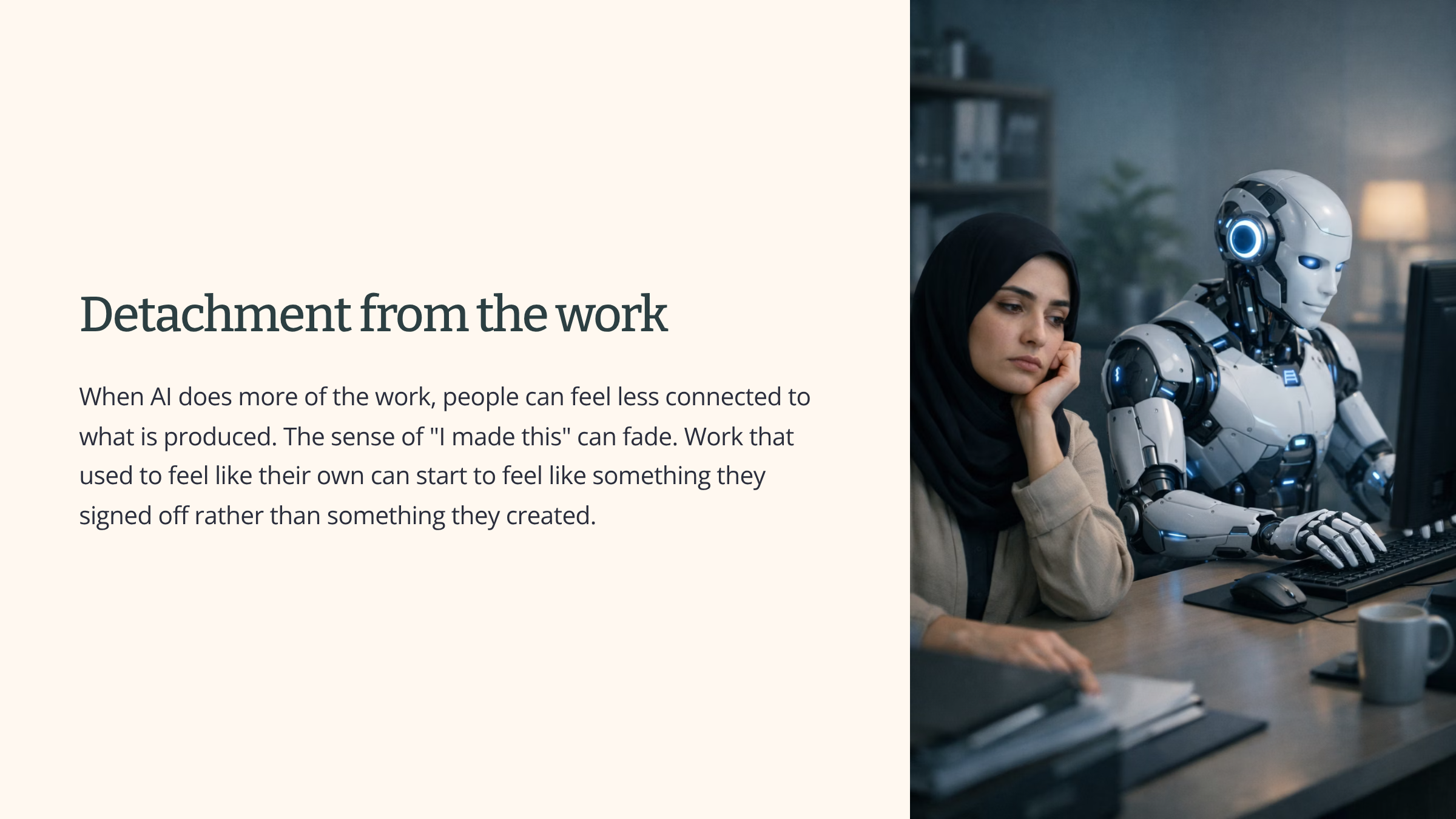
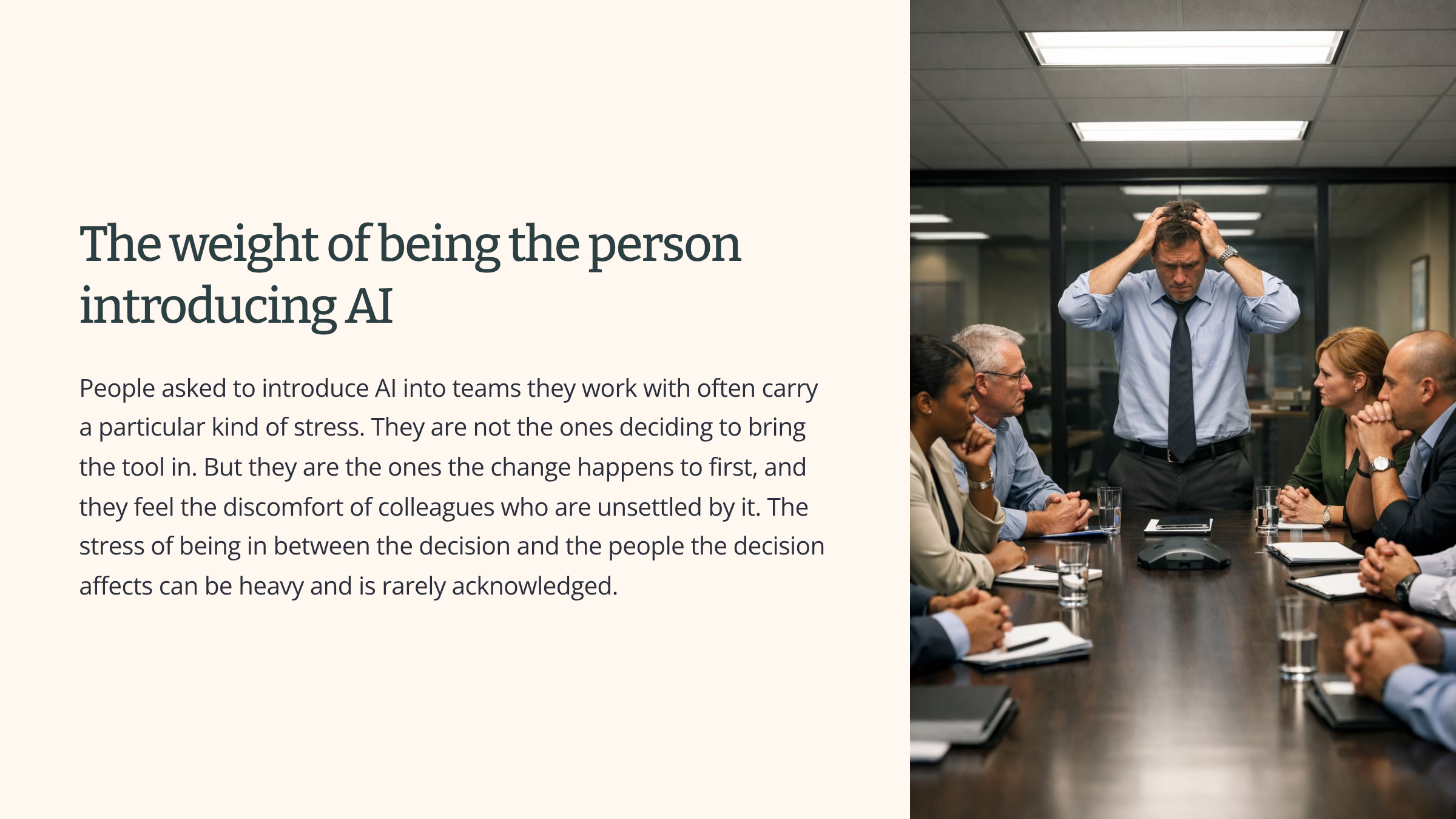
These culture and wellbeing effects are real and can be measured. They are also slow to surface, and rarely noticed by the people who made the decision to bring AI in. Often the picture from the top of an organisation looks different from the picture inside the team where the tool is being used.
See it in action
A team is eighteen months into using AI tools across most of their day-to-day work. The efficiency gains are real. The team is producing more reports, more analysis and more client communication than it did before the tools were introduced.
From senior leadership, the view is straightforward. The investment has paid off. Output is up. Costs are down. The adoption is held up as a good example for other teams.
Inside the team, the picture is more complicated.
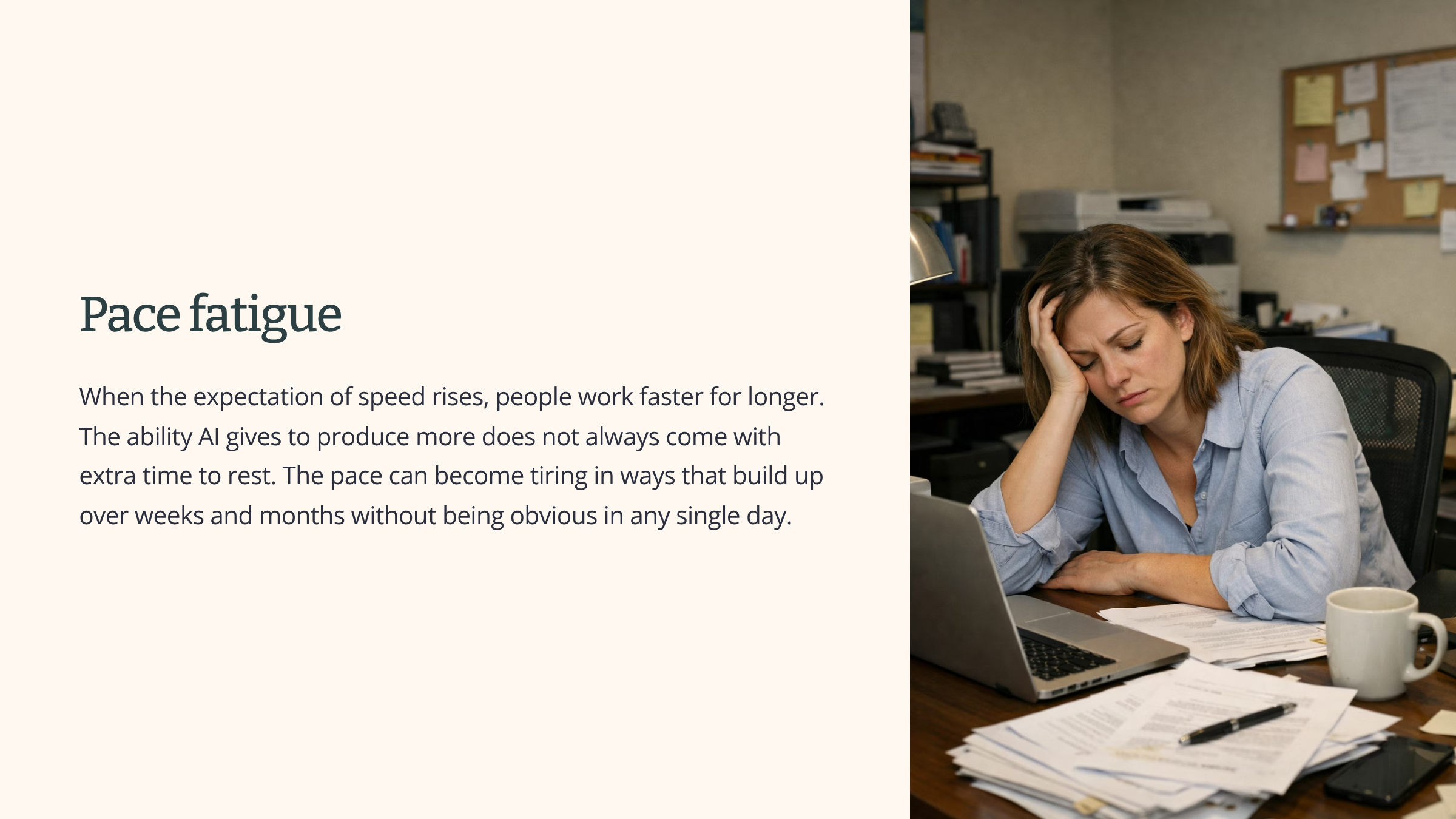
Pace has risen. The new baseline is fast, and people are working at that pace most days. Some of them are finding it hard to switch off in the evenings.
Some people on the team are using AI heavily. Others have quietly resisted, doing more of their own work by hand. The two groups are starting to be seen differently in performance conversations, even though no policy has been written.
A handful of small quality concerns have come up. None of them are big enough to be raised formally. But the team members know they exist, and they know they are the ones whose names go on the final work. The worry sits in the background.
A couple of people on the team have been asked to help bring the tools to other teams in the organisation. They are not deciding what to roll out. But they are the people the rollout happens through, and they end up feeling the discomfort of colleagues elsewhere who are unsettled by the change.
Both views of the adoption are accurate. From the top, the rollout is going well. From inside the team, several culture and wellbeing effects are also happening, even though they do not show up in the main numbers. Neither view on its own is the whole picture. The richer view is the one that holds both at once.
Summary
You now know how AI adoption affects a workforce. You know the patterns of impact on the work, the concerns that come up among people affected, and the effects AI adoption has on culture and wellbeing.
AI adoption is a change that happens to people, not just a change to work. The numbers in a rollout report are real. So are the concerns and the effects that often do not appear in those numbers. Seeing both honestly is part of what your role asks of you.