Equality, Employment and Fair Automation
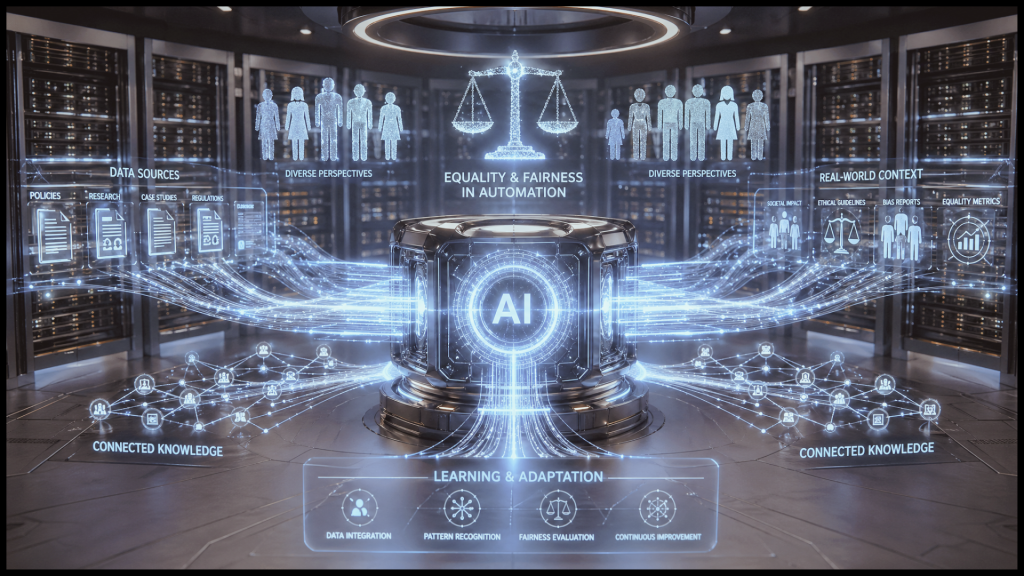
AI and automation systems make decisions that affect people. Who gets hired. Who gets served. Who gets flagged. Who gets the better price. Where those decisions disadvantage people on protected grounds, breach employment rights, or fall short of what the UK expects of AI in working life, the law has something to say. Professional practice expects more than the legal floor as well.
The role you are working in is often the closest one to the moment those questions show up. The law and the principles around it only matter when someone close to the work spots the moment they apply, acts on the part of the response that sits with them, and raises the rest with whoever holds it.
In this section you will learn:
- how the Equality Act 2010 applies to decisions made by AI systems
- how indirect discrimination shows up in AI work, and what the signals are
- which employment rights become relevant when AI affects how work is done
- the direction the UK has taken on AI regulation and which regulators matter
- how to recognise an equality or employment duty in live AI work, act within your role, and raise it up where it sits beyond your role
What the Equality Act 2010 requires
The Equality Act 2010 is the main UK law against discrimination. It sets out what counts as unlawful treatment and who is protected. It applies to decisions about people in employment, in the provision of goods and services, and in some other public-facing contexts.
The nine protected characteristics
The Act protects people from being treated less favourably because of any of these:
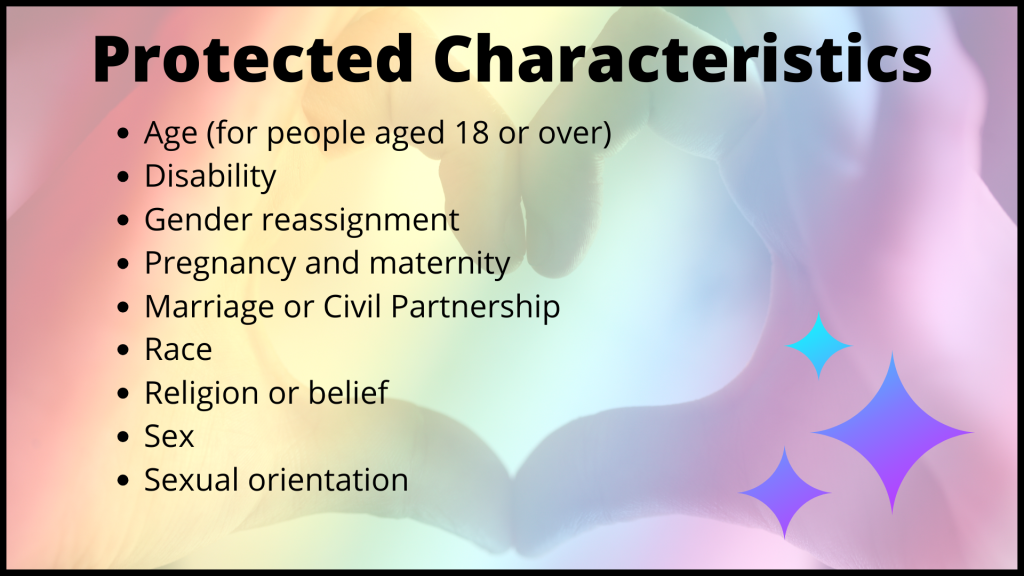
These are the grounds on which less favourable treatment is unlawful. Where a person fits one or more of them, the Act gives them protection.
The four forms of unlawful discrimination
The Act names four main forms of unlawful discrimination.
Direct discrimination is treating someone less favourably because of a protected characteristic. For example, refusing to interview someone because of their age.
Indirect discrimination is applying a rule or way of working that looks the same for everyone but puts people with a protected characteristic at a disadvantage. It is unlawful where the rule cannot be shown to be a fair way of meeting a real need. This is the form that comes up most often in AI work.
Harassment is unwanted conduct connected to a protected characteristic that has the purpose or effect of upsetting someone or creating an intimidating, hostile or degrading environment.
Victimisation is treating someone badly because they have raised a concern about discrimination or supported someone else who has.
Reasonable adjustments
For people with a disability, the organisation has a duty to make reasonable adjustments so they are not put at a substantial disadvantage. This is an active duty. The organisation has to do something. It is not enough to simply avoid discriminating.
The Public Sector Equality Duty
Public bodies, and organisations carrying out public functions, have an extra duty. They must actively work towards eliminating discrimination, advancing equality of opportunity, and fostering good relations between people with different protected characteristics. This is called the Public Sector Equality Duty. Where the work you are doing sits inside or alongside a public body, this duty is in play.
Why this applies to AI systems
The Act applies to decisions, not to who or what made them. A decision made by an AI system that disadvantages someone on protected grounds is still unlawful under the Act. The organisation is responsible for the decisions its systems make, in the same way it is responsible for decisions a person in the organisation makes. There is no special exception for AI.
Indirect discrimination in AI work
Direct discrimination is usually easy to see. A person or a system is using a protected characteristic to make a decision. Indirect discrimination is harder. The system names no protected characteristic. The rules look the same for everyone. But the outcomes the system produces disadvantage people with a particular protected characteristic. That can still be unlawful if the rule cannot be shown to be a fair way of meeting a real need.
This is where most AI-related discrimination risk sits. It is also the form that is hardest to spot.
How it happens: proxy features
The usual way it happens is through a proxy. A proxy is a feature in the data that stands in for a protected characteristic without naming it. The system is not looking at the characteristic directly. But the feature it is using is so closely tied to that characteristic that the effect lands the same way.
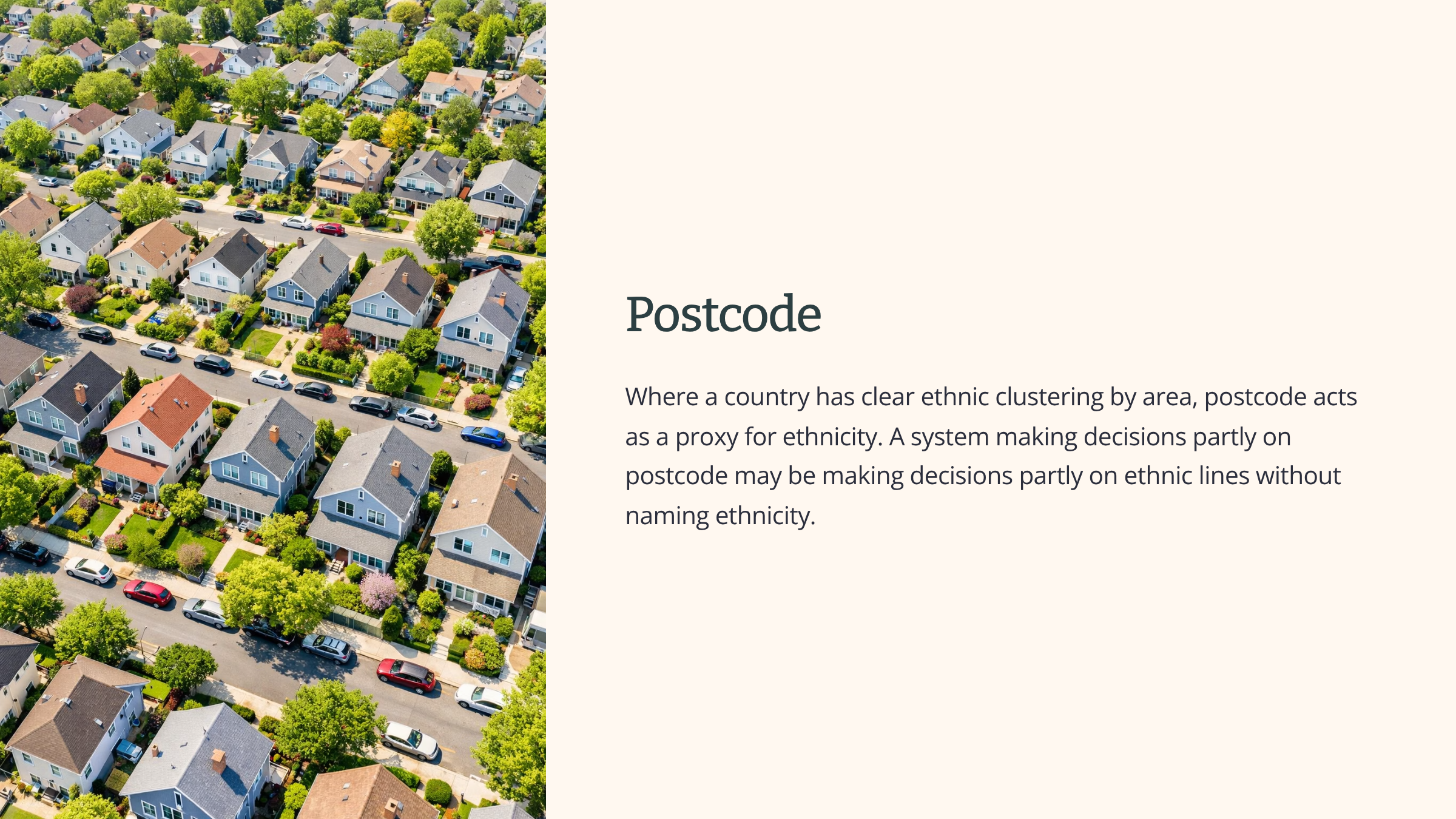
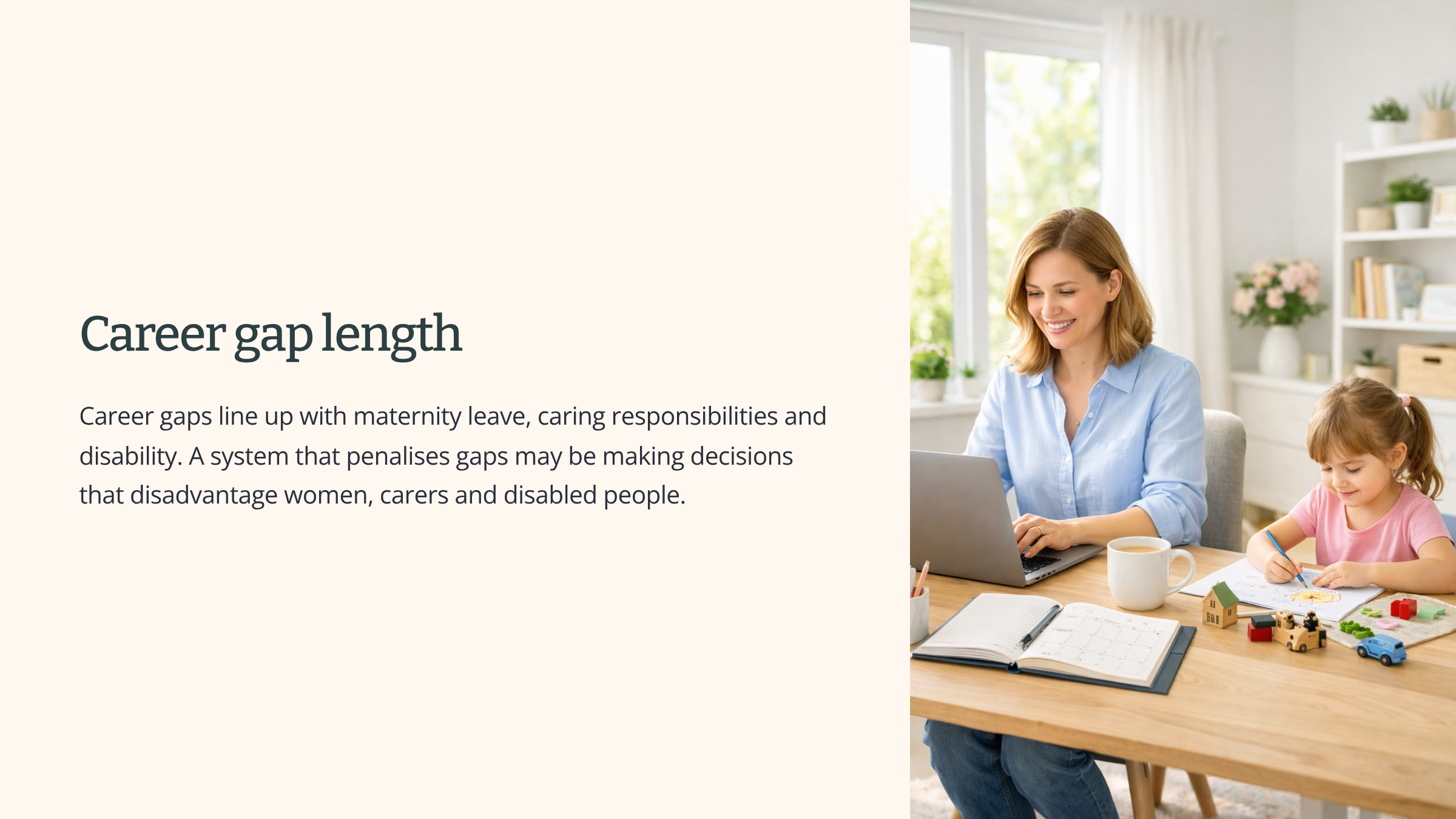
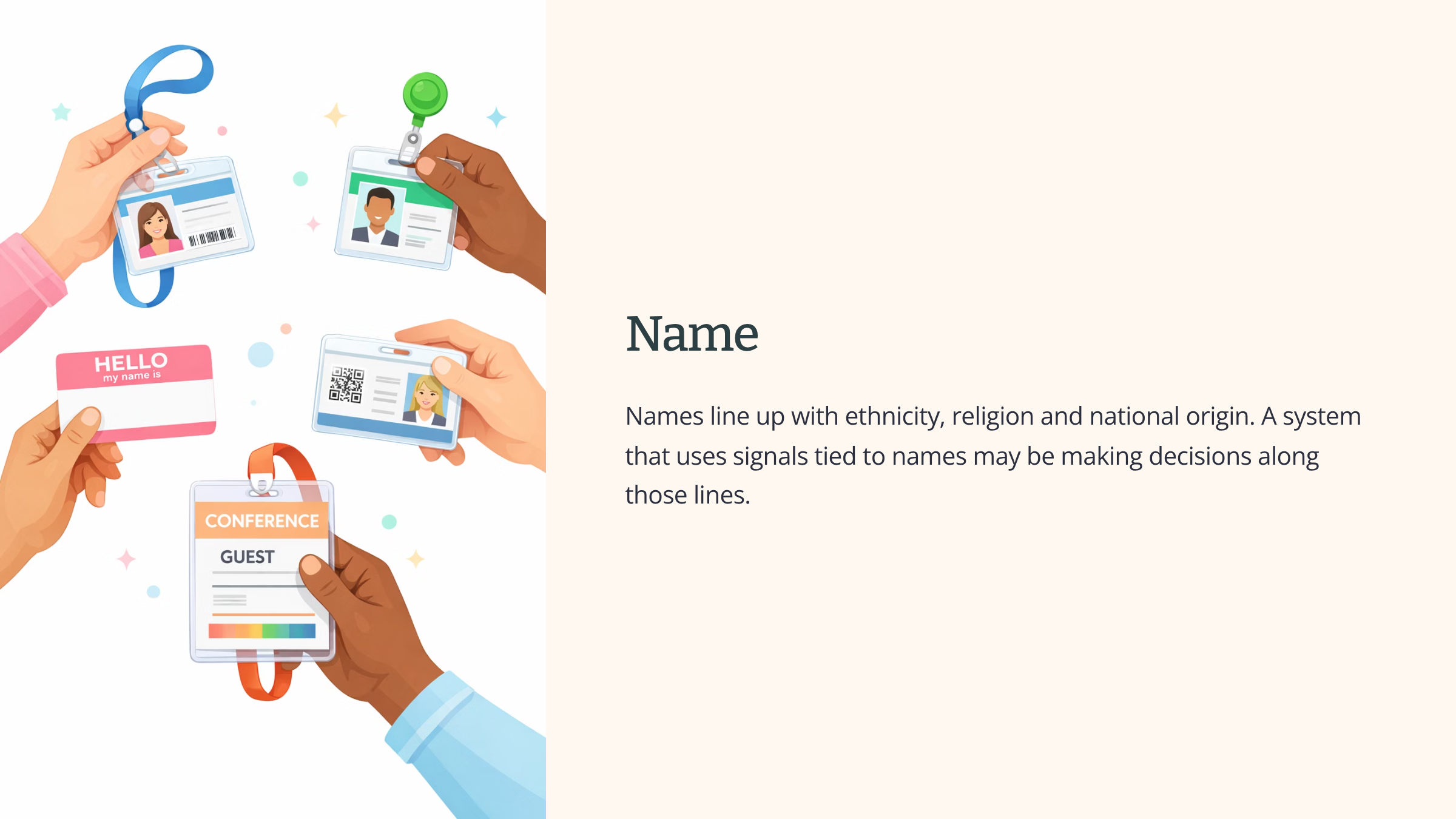
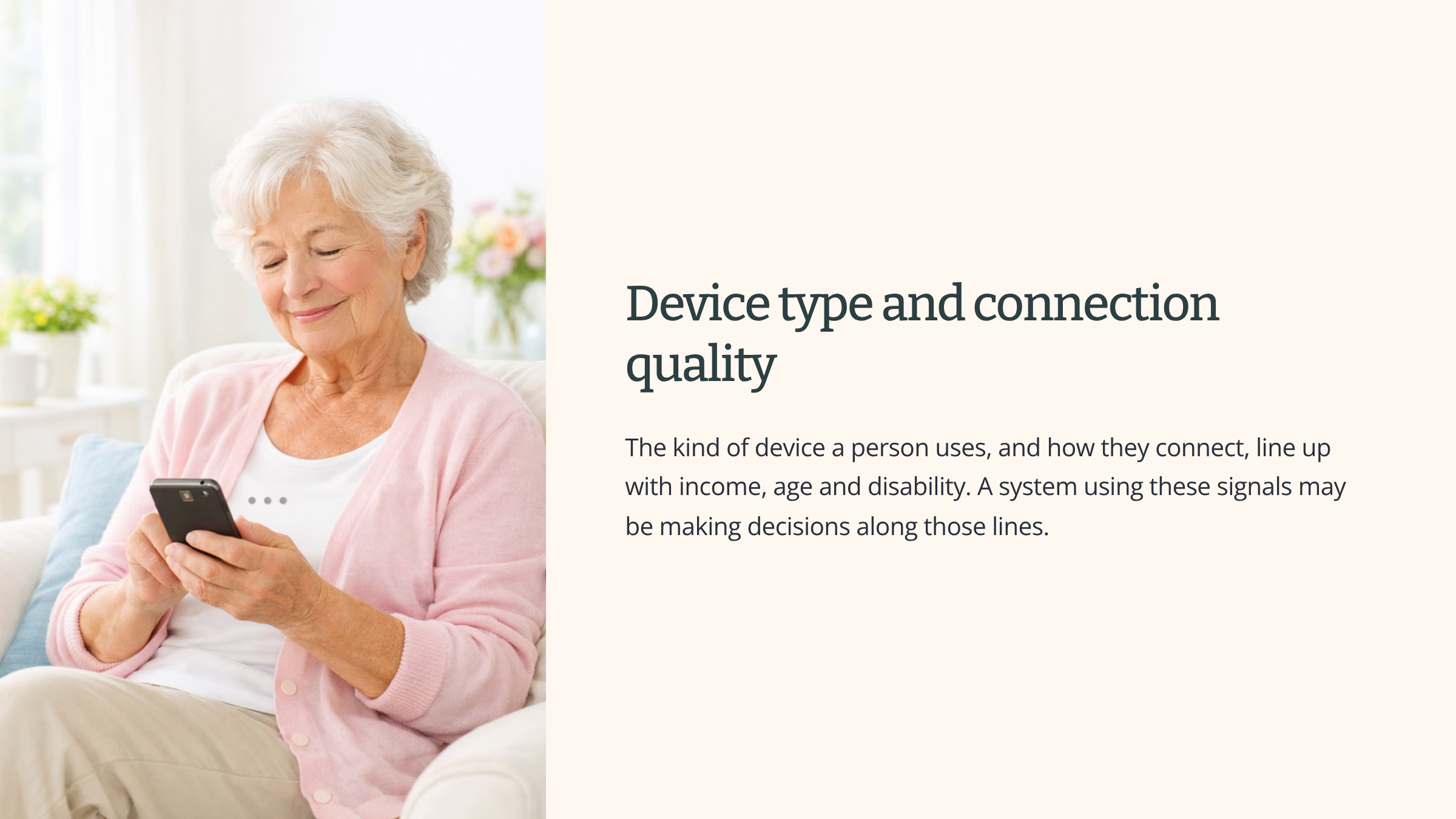
The system has not been told to discriminate. It is using features that look neutral. But the effect lands on protected characteristics anyway.
What outcome disparities tell you
If an AI system’s outputs are clearly worse for people with a protected characteristic than for others, that is a signal that indirect discrimination may be in play. The disparity is not proof of unlawful discrimination on its own. The organisation may have a fair reason for the rule. But the disparity is the signal that needs attention. You do not let it pass.
Crossover failures
A system can perform reasonably for each protected characteristic on its own and still fail for people who sit at the crossover of two of them. A system that works for women, and works for one ethnic minority group, can still fail for women from that minority group. These crossover failures often do not show up in headline numbers, because the group is small enough that its results get averaged out. They are easy to miss.
Knowing these failures happen is what matters at this stage. Picking them up requires the work to be set up to look for them.
Employment rights and AI in the workplace
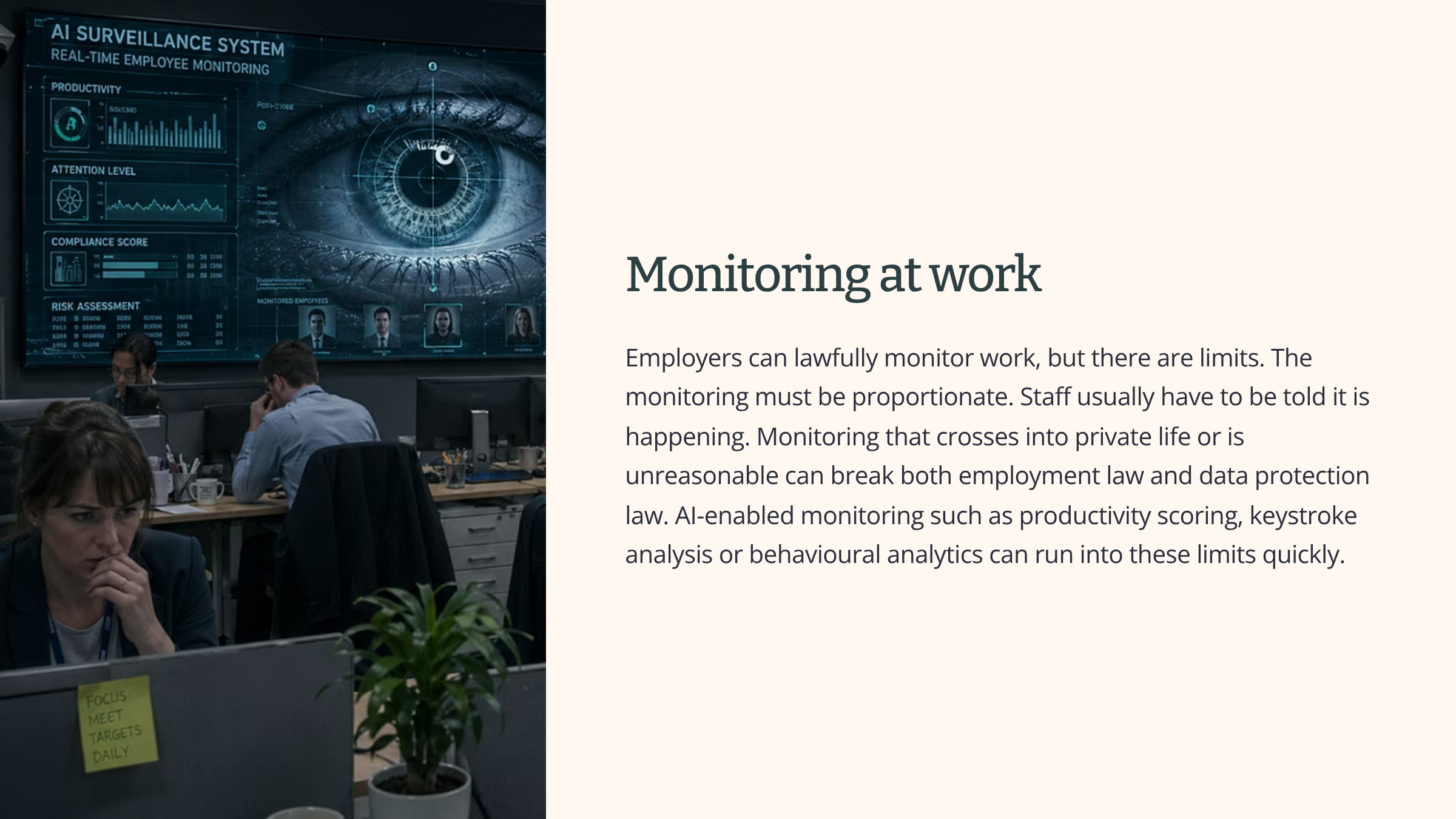
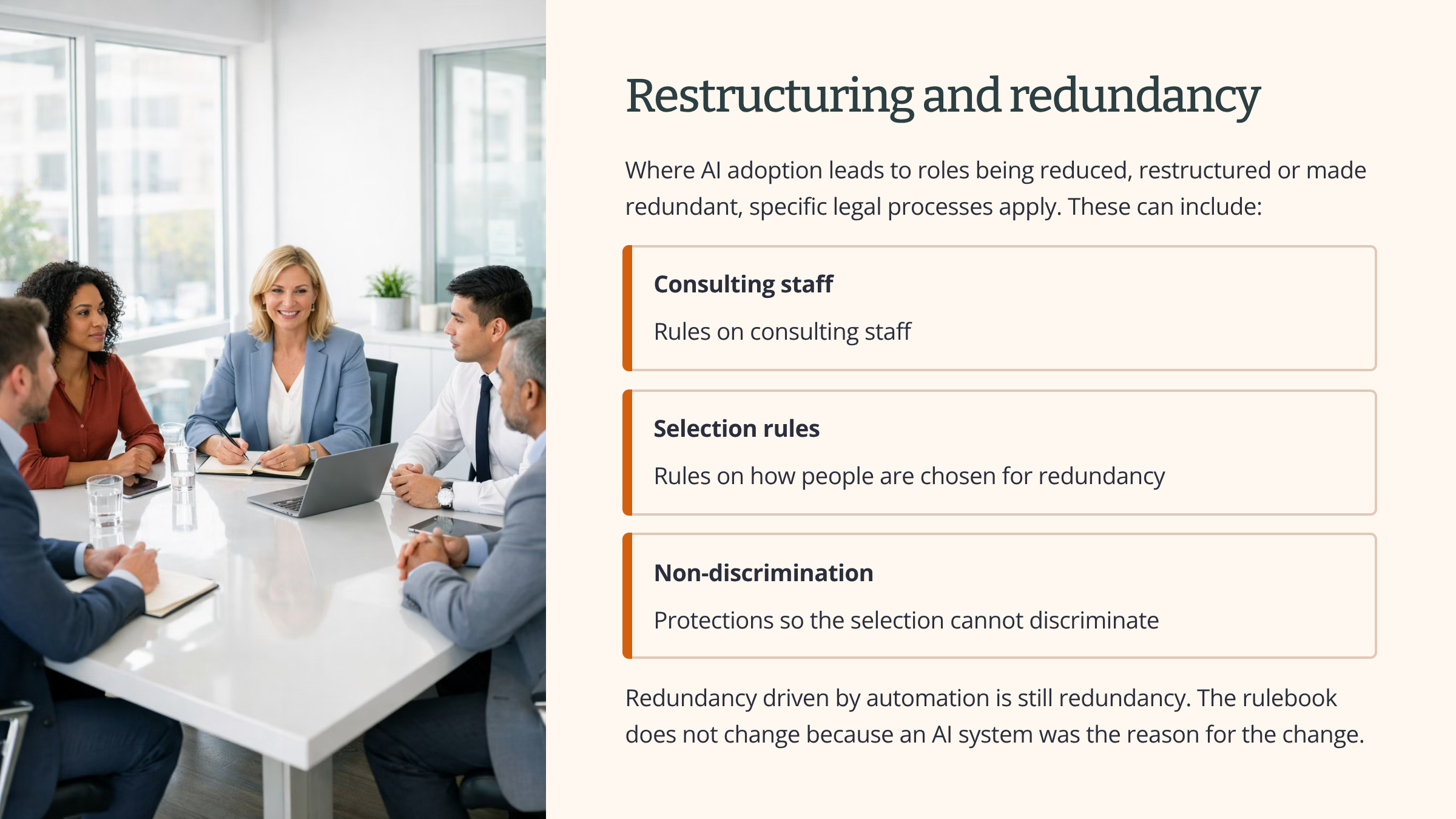
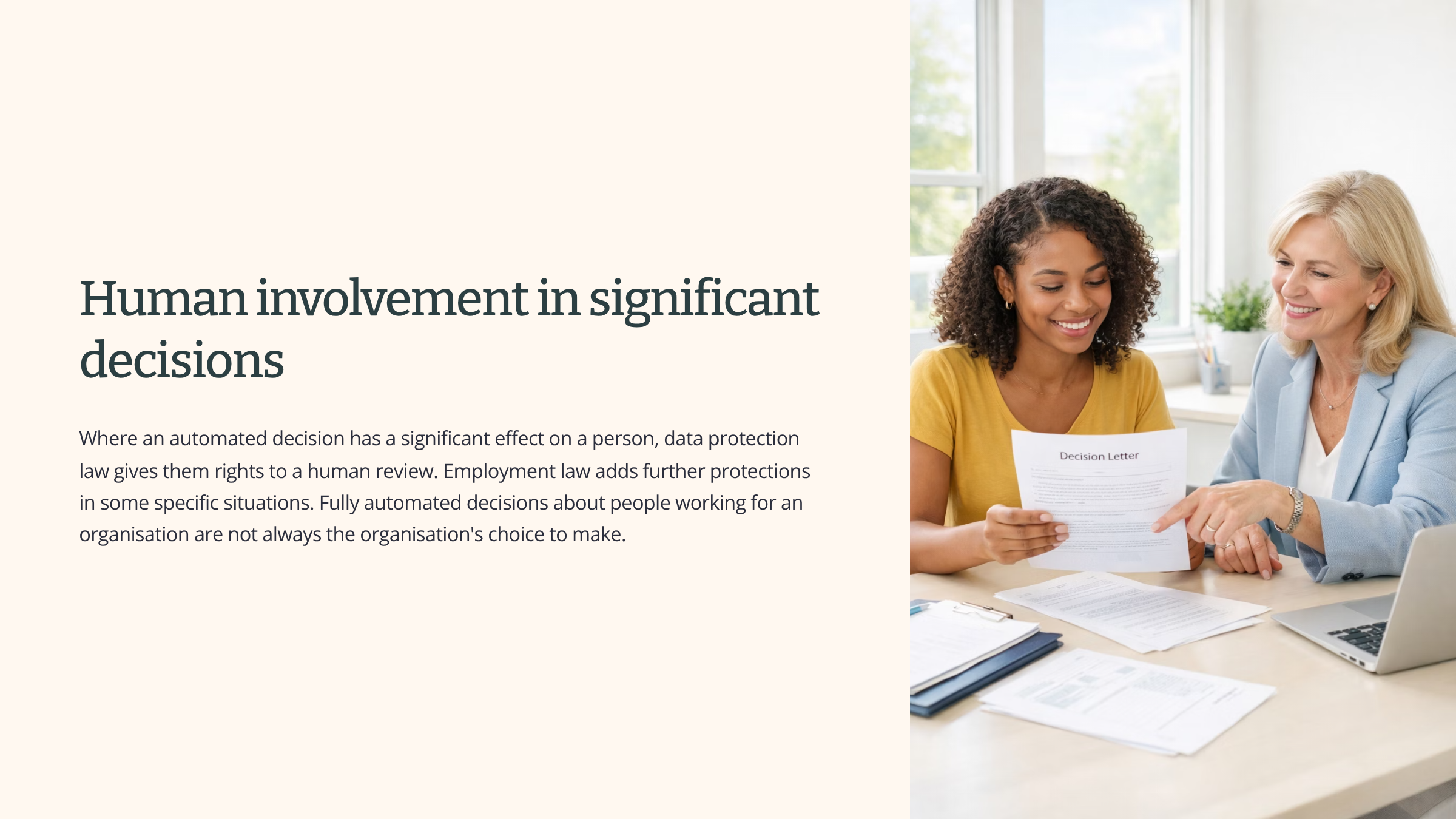
When AI and automation affect how work is done, certain employment rights become relevant. You do not need a full employment law course at this stage. What you need is to recognise the rights you are most likely to come across in your role and to know they exist.
The UK’s direction on AI regulation
The UK has taken a distinctive approach to AI regulation. Rather than passing a single dedicated AI law, it has relied on existing regulators to apply cross-cutting principles in their own sectors. This position has been changing, and what is in force at any given time is worth checking.
The cross-cutting principles
The principles the UK has used to guide AI regulation are:
- safety, security and robustness
- appropriate transparency and explainability
- fairness
- accountability and governance
- contestability and redress
These are applied through the existing regulators in their own areas, rather than through a single AI regulator.
The regulators that matter
The regulators most likely to come up in your work are:
- the Information Commissioner’s Office (ICO) for data protection
- the Equality and Human Rights Commission (EHRC) for equality
- the Financial Conduct Authority (FCA) for financial services
- Ofcom for communications and online safety
- the Competition and Markets Authority (CMA) for competition
- sector regulators in healthcare, transport, energy and other areas, for their own areas of work
You do not need to apply the regulations yourself. You need to know they exist, know which regulator is the right point of contact for which kind of concern, and recognise that AI decisions in your work sit inside this environment.
The EU AI Act
The EU AI Act is not UK law. It still matters. UK organisations that work with EU customers, EU staff, or EU operations often fall within its reach. If your organisation has any kind of EU exposure, the EU AI Act may apply to some of what you do. It is worth knowing the Act exists and that it can apply to UK-based work.
Ethical principles alongside the law
The law sets the floor. Ethical principles sit above it. There are things that may be legal but still wrong. There are things expected of professionals working with AI even where the law does not specifically require them. These principles are part of how good practice operates, not optional extras.
Three principles matter here as professional standards.
Fairness
Fairness
Fairness means treating people affected by AI systems fairly. Not just avoiding unlawful discrimination, but thinking about whether the system treats people well given the context it operates in. Fairness can pull in different directions. What is fair between two individuals can be different from what is fair across two groups. There is no single setting that satisfies every meaning of fair at once. Recognising that tension is part of the principle.
Transparency
Transparency
Transparency means being open about what AI is doing, how it is making decisions, and what people can do about it. There are several layers. Transparency to the people affected by the system. Transparency to the wider organisation. Transparency inside the team doing the work. Transparency does not always mean publishing the technical details. It means the people who need to engage with the system have what they need to do that honestly.
Accountability
Accountability
Accountability means someone is answerable for what an AI system does. A system cannot be answerable to anyone. The organisation that runs the system, and the people in the organisation who hold the relevant roles, carry the accountability. Accountability includes being able to show how decisions were made, respond when something goes wrong, and change the system when it is not working.
Where law and ethics meet
Where the law speaks clearly, doing what the law requires is the minimum. Where the law is silent, the ethical principles fill the space. Professional practice expects both. The question is not “what can I get away with.” The question is “what is the right thing to do given everything I know.”
Recognising equality and employment duties in live AI work
Why recognition matters
Understanding the Equality Act and wider ethical principles is only useful if you can recognise when they apply in real situations. The key skill is not recalling rules, but noticing when those rules are relevant in the work happening in front of you.
In this role, you are not expected to act as a legal expert. You are expected to recognise when something may need closer attention and to question it.
Where this shows up in AI and automation work
This becomes important in everyday AI and automation work, where decisions, patterns, and outcomes can affect people in different ways.
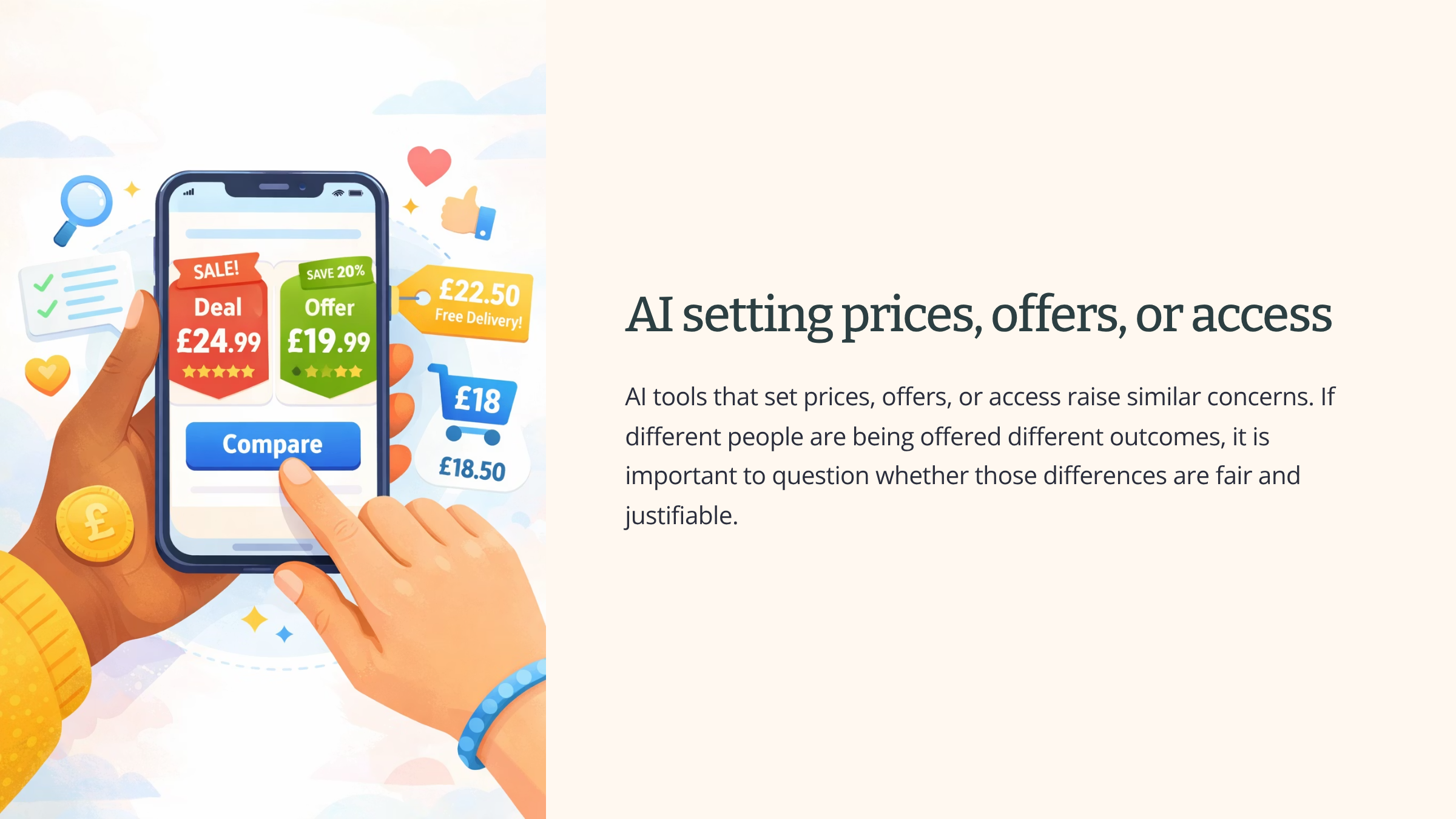
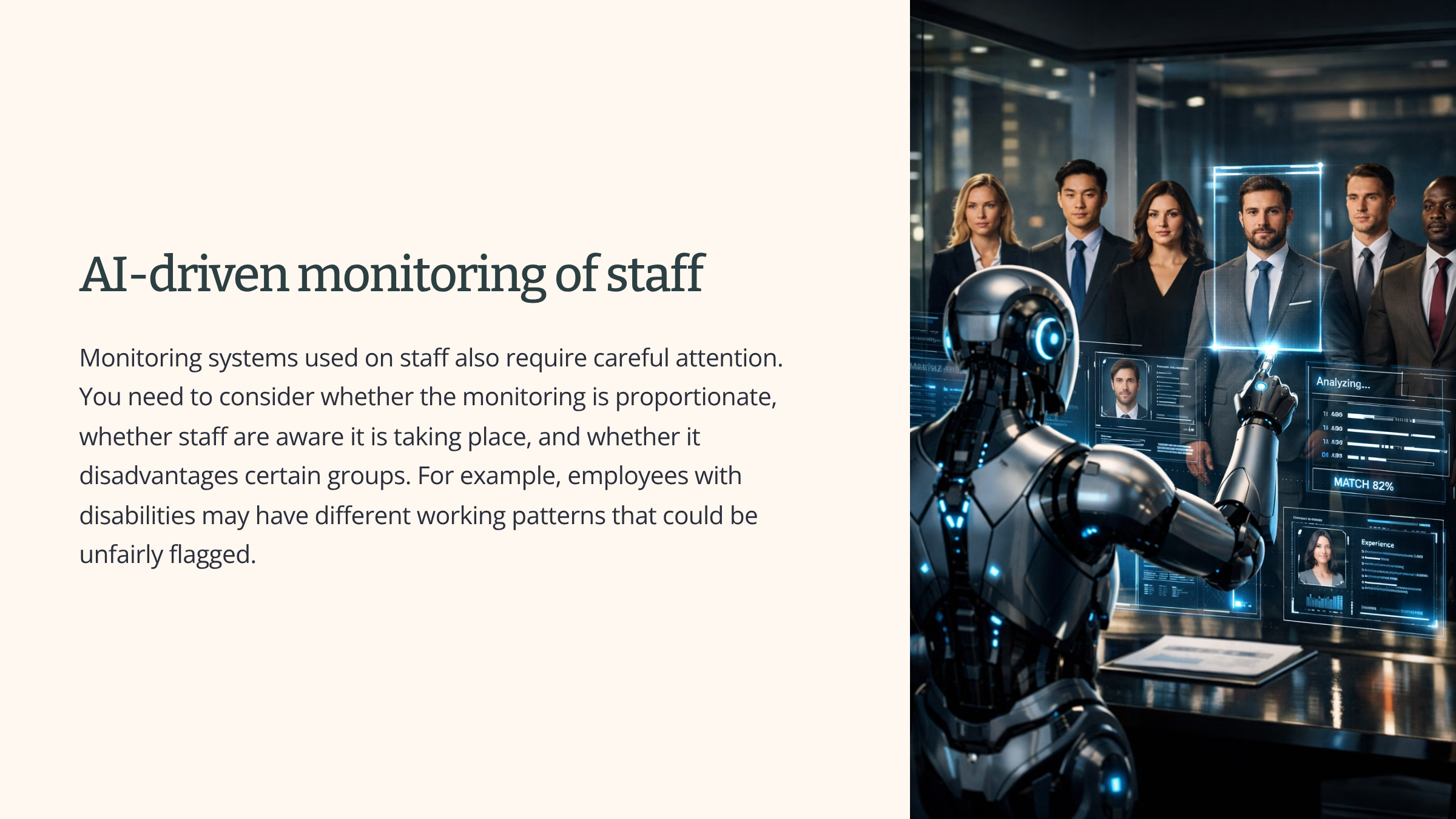
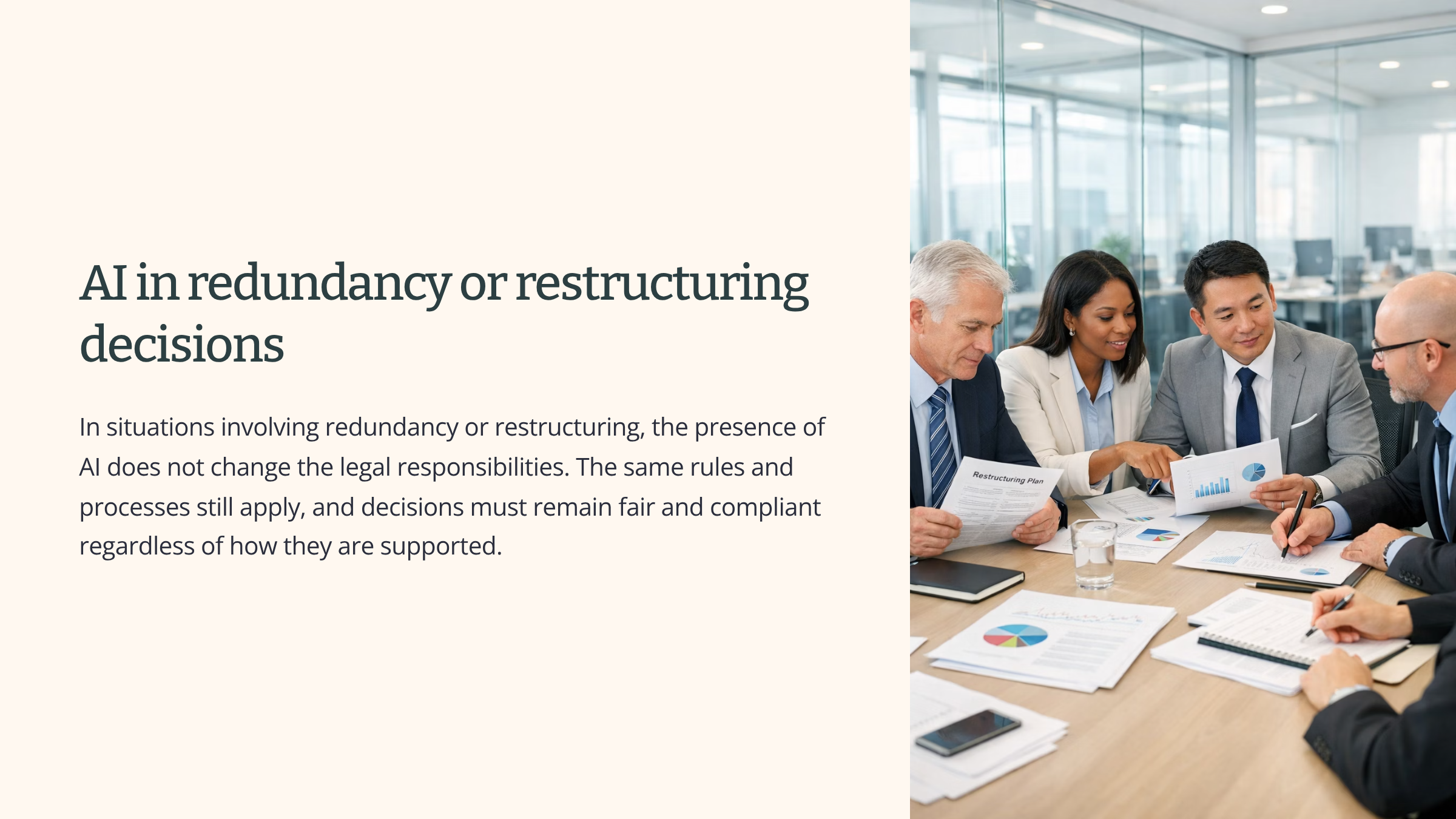
What to look for
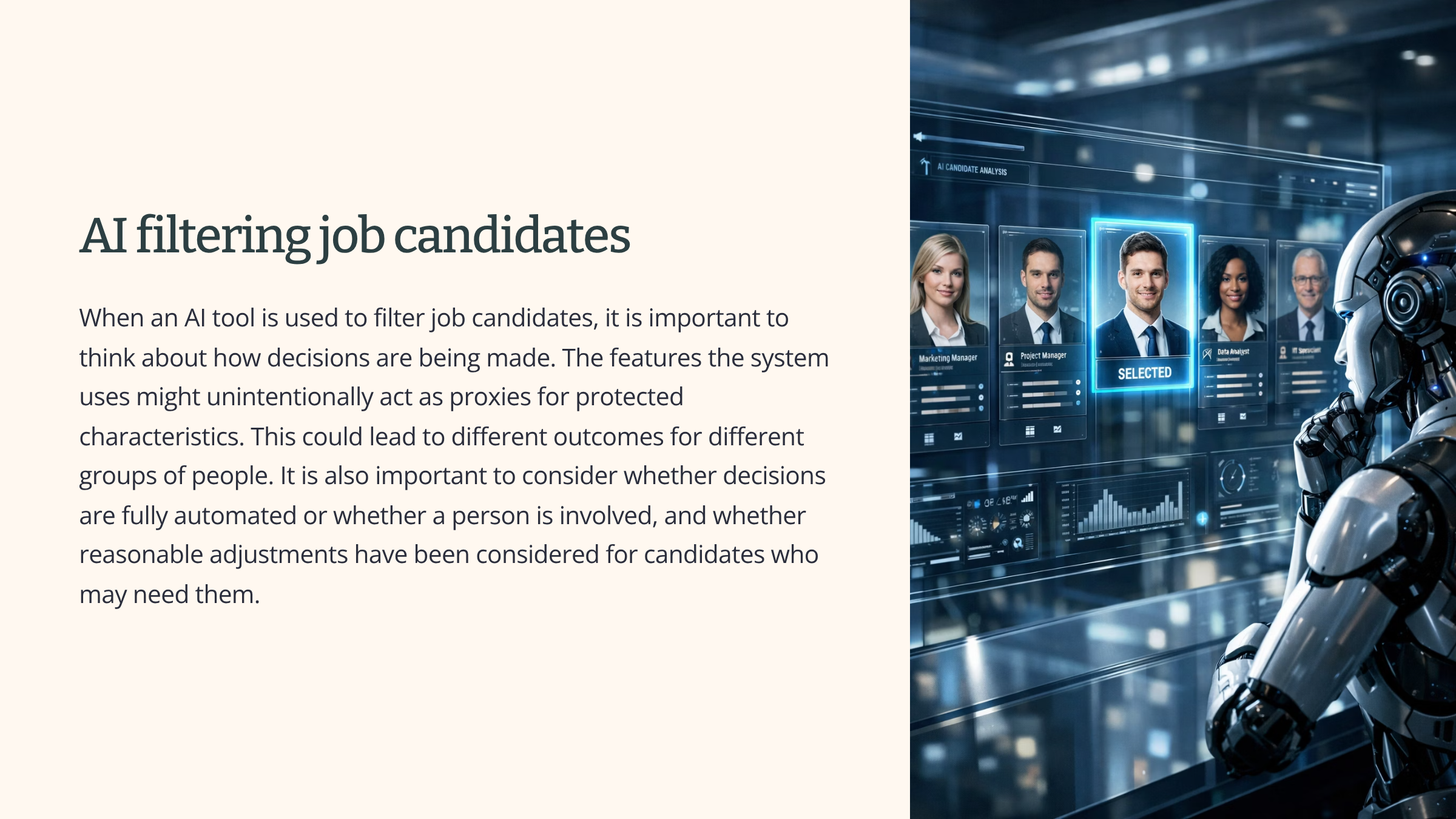
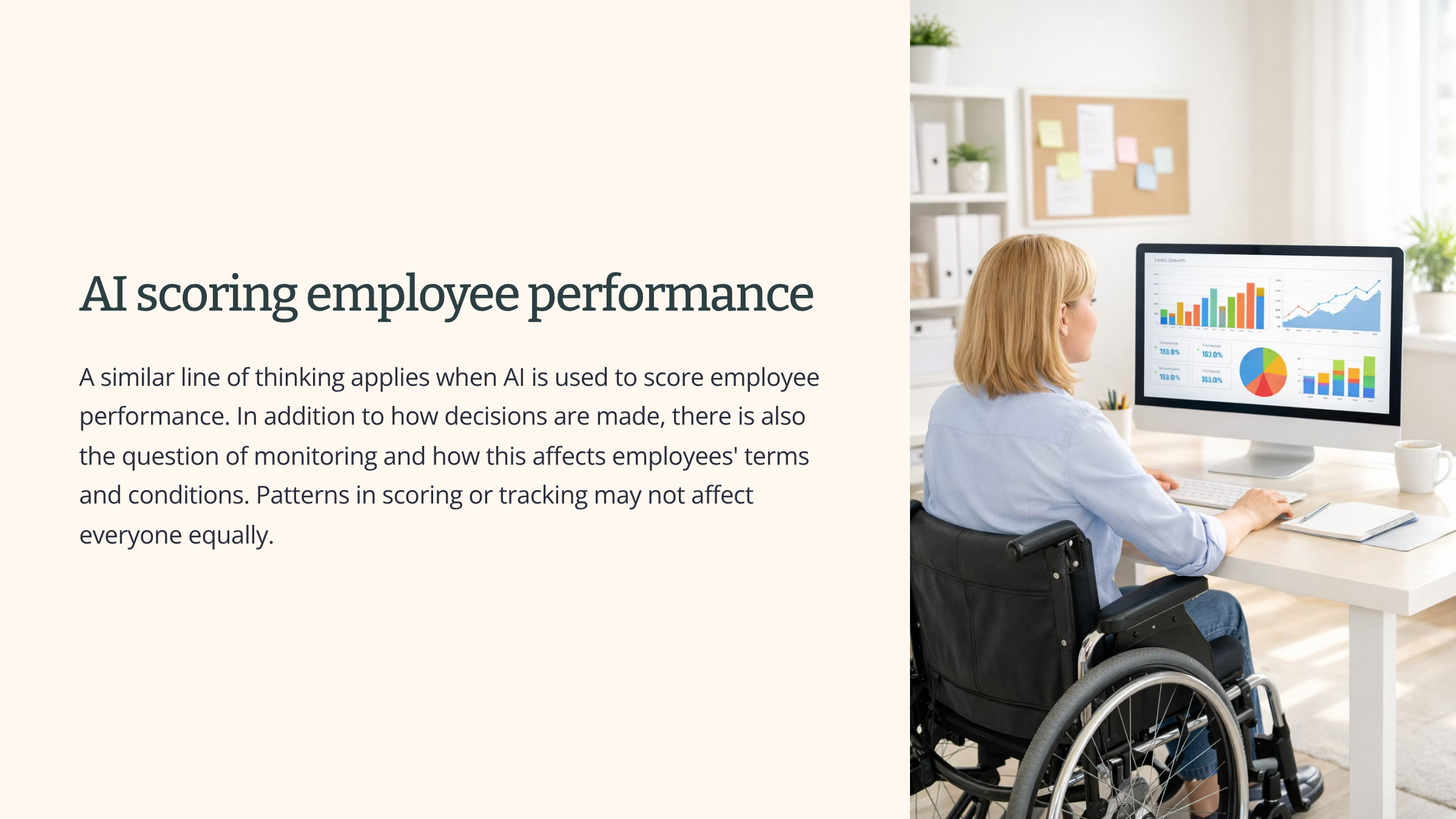
Across all of these situations, the task is to recognise common warning signs. These include the use of features that could indirectly represent protected characteristics, differences in outcomes between groups, and decisions that affect people without meaningful human involvement. It also includes noticing when monitoring or automation may be changing working conditions, or when patterns have not been properly reviewed.
Recognition is an ongoing responsibility
Recognition is not something that happens at the end of a project. It is an ongoing judgement made during the work itself, where you notice risks early and respond before they become issues.
See it in action
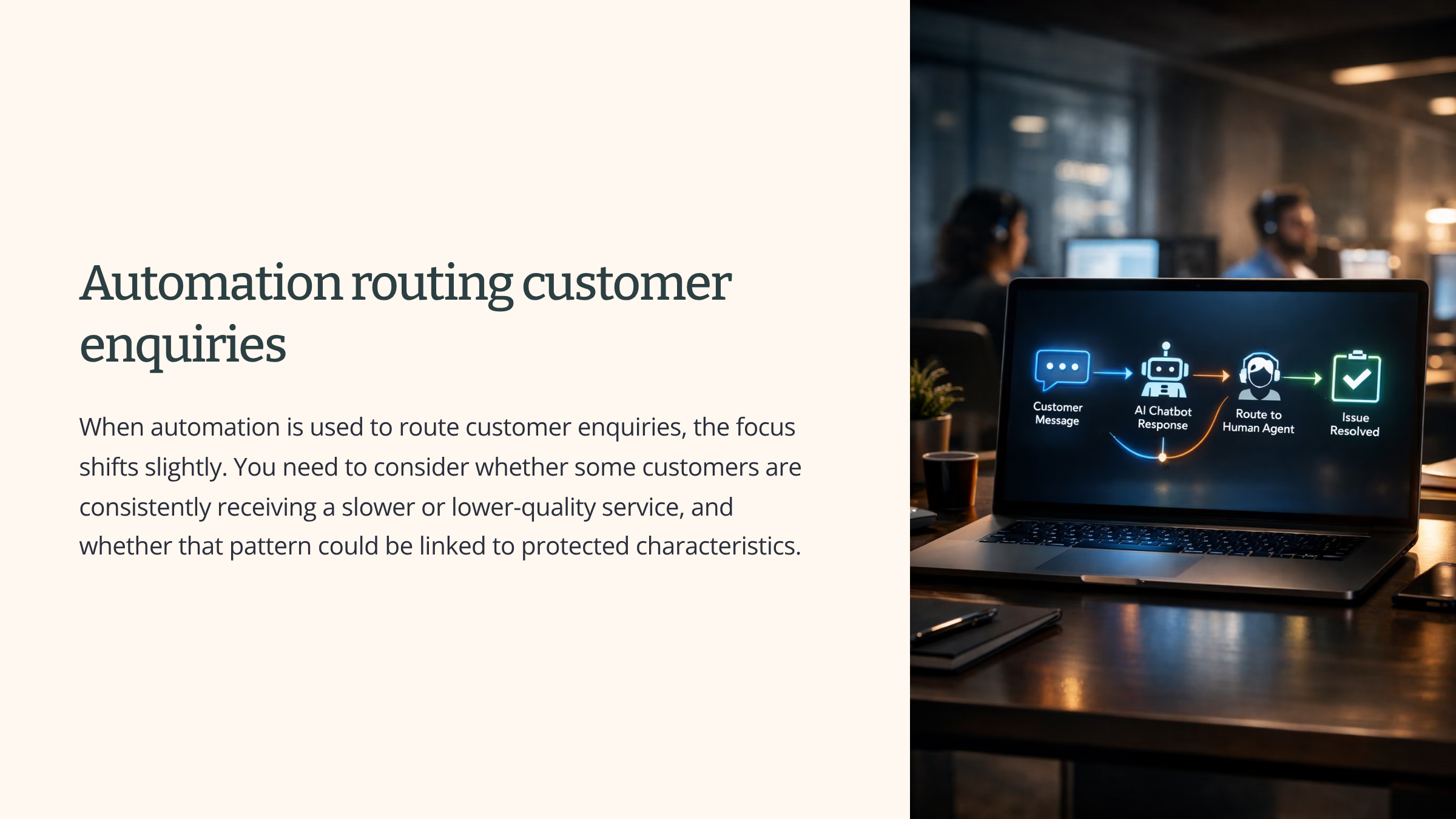
A team is piloting an AI tool to triage incoming customer service enquiries. The tool sorts each enquiry into one of three queues, with different response times and different levels of staffing.
Two weeks in, you are looking at the data with the team. You notice that enquiries from one postcode area are being routed to the lowest-priority queue at a much higher rate than the other postcode areas. The customers in that area are waiting longer for help.
You stop and think. Postcode is not, on its own, a protected characteristic. But the area in question has a high concentration of one ethnic group and a lower average income than the other areas the tool covers. Postcode is a likely proxy here. The pattern in the routing maps onto ethnicity and income, even though the tool has not been told about either.
The signal is enough to take seriously. The tool is producing outcomes that fall harder on a group that has protected characteristics. There may be a fair reason for it. There may not. Either way, the duty is live now, not at the next quarterly review. You name what you have seen and treat it as a recognition moment.
The call you have made is not “the tool is unlawful.” It is “this is a signal of indirect discrimination risk, and it needs to be looked at properly.” That is what recognition at this level means in practice.
Responding and raising it up in your role
Recognition is the first half of the capability. Knowing what to do once you have recognised the duty is the second.
The basic shape of the response holds across most situations. Pause the action where you can. Record what you have seen. Raise it to the right person. Adjust how the work is being done if a recurring risk has surfaced.
What you do directly
You can pause or stop the action where it is yours to do. If a system is about to be deployed, it can usually be paused while the concern is looked at. If it is already live, the team can be made aware and the situation watched closely while the concern is worked through.
You record what was recognised and what you did. A clear, factual note. Not a report for an outside audience. A record that makes sense to you, or to someone else, if it is returned to later.
You raise it to the right person.
Where each kind of concern usually sits:
- equality matters often sit with HR, with legal, with a compliance role, or with a named person responsible for equality across the organisation
- employment matters often sit with HR
- ethics concerns may sit with the same people, or with a specific ethics function where one exists
Where no clear owner is in place, line management is the starting point and the route up from there.
You adjust the work pattern if the situation has shown a recurring risk. If the same kind of issue has come up twice, looking for it the next time becomes part of how the team works.
What you do not do
Some parts of the response sit with other roles.
- You do not make the final call on whether unlawful discrimination has happened. That sits with legal, with HR, or with an outside body.
- You do not design the investigation into a discrimination concern. That is specialist work.
- You do not commit the organisation to a position with the outside world. That is also specialist work.
The boundary matters because acting beyond your role can damage the organisation’s response and your own position in it.
Where the route in your organisation sits
Find out, before something surfaces, who in your organisation holds:
- equality responsibility
- employment responsibility
- ethics responsibility
It may be one person. It may be several. It may be split in ways that are not obvious. Knowing in advance saves time when something needs raising.
The whistleblowing safety net
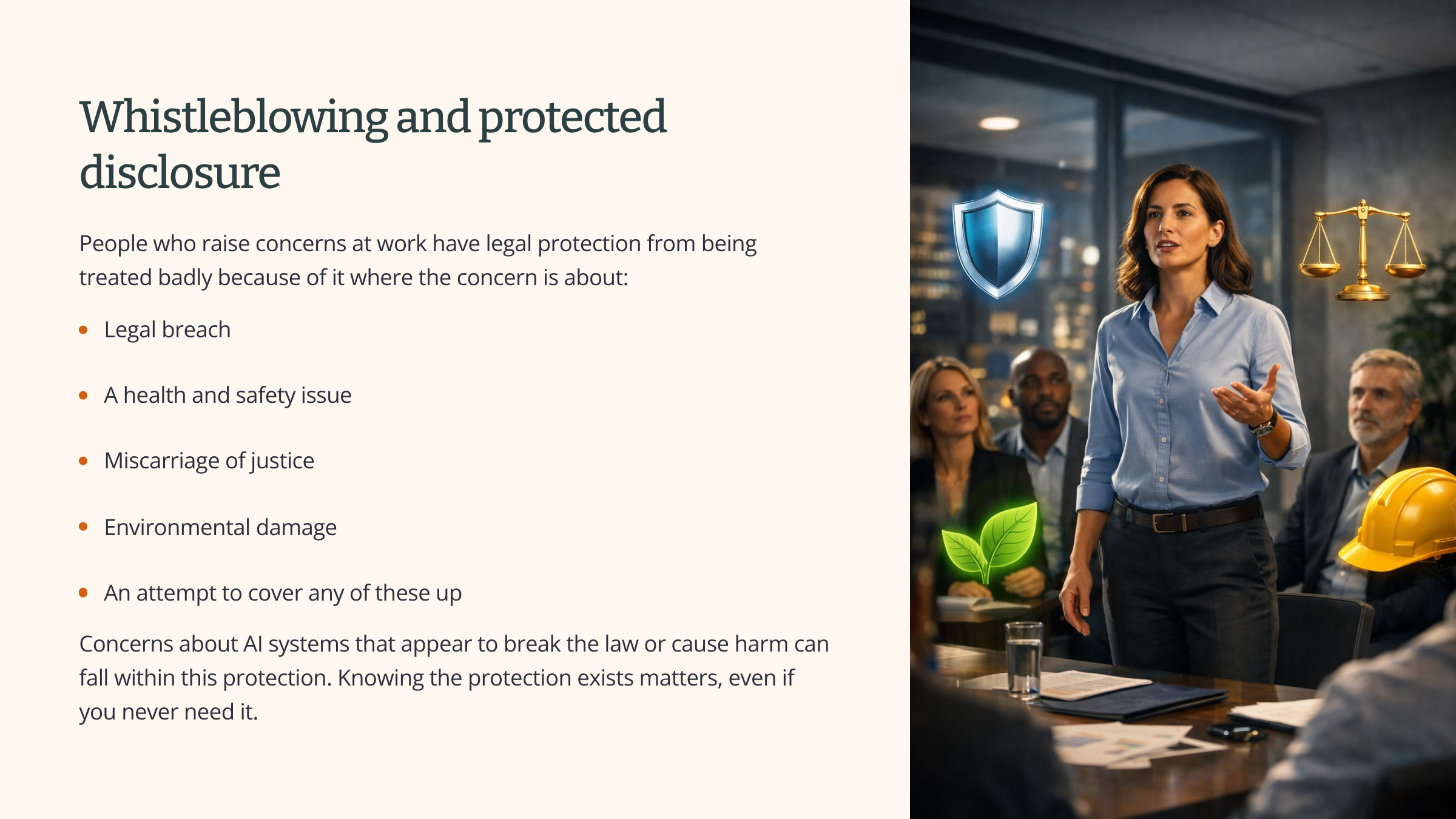
There are times when a concern has been raised through the right route but is not being acted on. There are also times when the concern is serious enough that waiting for internal processes is not the right response. In those situations, the law gives protection to people who make protected disclosures. This is not a route to use lightly. It is worth knowing it is there.
See it in action
The triage tool. The postcode disparity has been noticed. Now the response.
You speak to the team running the tool and ask for the routing to be paused for the affected postcode area while the disparity is looked into. The team agrees. Until the question is resolved, those enquiries go through the standard queue rather than being sorted by the tool.
You write a short note for yourself and for the work record. What you saw in the data. What pattern you saw. Why you think it is worth taking seriously. What was paused and when. Who you spoke to. The note is plain and factual. It will make sense in three months if anyone needs to come back to it.
You raise it to the right person. Your organisation’s equality lead sits within HR. You go to that HR lead. You explain what you have seen, what you have already done, and what you think they need to know. You hand the situation to them.
What happens next is not yours to do. The investigation into whether the disparity is unlawful sits with people who hold that decision. The analysis of how the tool is producing the disparity sits with the team running it. The decision about whether to keep using the tool or change it sits with the people who hold that call. Your part finishes at raising it cleanly.
The reasoning is what matters. You did not wait for someone else to notice. You did not push past the boundary of your role and try to decide whether the law has been broken. You acted on the recognition, did what was yours to do, recorded it, and handed it up. That is what acting in role looks like.
Summary
Working with AI and automation responsibly depends on more than knowing the law. It depends on recognising when an equality or employment duty is in play in the work in front of you, acting within the part of the response that sits with you, and raising the rest with whoever holds it.
Strong practice means watching for proxy features and outcome disparities, recognising employment rights when AI work brings them into play, holding fairness, transparency and accountability alongside the law, and raising things cleanly when they sit beyond your role. The person closest to the AI work is often the only one who can see when a duty is live. When you work this way, equality and employment are not a separate question that sits next to the AI work. They are part of how the AI work is done.